
A dead shore power cord at 2:13 a.m. does not care whether you were planning to check on the boat tomorrow. Neither does a stuck bilge pump, a drained house bank, or a hatch left open before a hard rain. That is the real test behind any connected boat monitoring review – whether the system gives you enough warning to act before a minor issue turns into a repair bill, an insurance claim, or a ruined weekend.
For most owners, remote monitoring is not about gadget appeal. It is about risk control. Boats sit unattended for long stretches, often in environments that are hard on wiring, batteries, and electronics. A useful system has to do more than show a map dot in an app. It needs to watch the conditions that actually damage boats, send alerts through channels you will notice, and keep working in a marine environment where consumer-grade devices tend to fail.
What matters in a connected boat monitoring review
The first question is simple: what is the system watching? If it only tracks GPS position, you are buying a tracker, not a monitoring platform. Position alerts matter for theft and unauthorized movement, but many of the most expensive marine problems start long before the boat moves. Shore power loss can shut down chargers and air conditioning. Battery voltage can slide for hours or days before the boat will not start. Water intrusion and bilge cycling can signal a leak when there is still time to respond.
A strong connected boat monitoring review should look at coverage across the full risk picture. That includes shore power, battery health, high water, bilge activity, temperature, humidity, doors and hatches, GPS location, geofencing, and anchor position. For owners of larger or more system-heavy boats, NMEA2000 integration also matters because it brings engine, transmission, and tank data into the same view. That reduces guesswork and makes the app genuinely useful rather than occasionally interesting.
The second question is how alerts are delivered. Push notifications alone are not enough for many boat owners. Phones get silenced. Apps get buried. If the system cannot escalate through SMS, email, or phone calls, you may not learn about a serious event until too late. Fast notice is the whole point. Monitoring without dependable alerting is passive data collection.
The difference between marine monitoring and generic IoT
This is where many systems separate quickly. Plenty of off-the-shelf sensors look attractive on price, but boats are not spare bedrooms and marina slips are not climate-controlled garages. Salt, vibration, moisture, intermittent power, and variable connectivity expose every weak point. A product that works fine in a house can become unreliable on the water.
That is why hardware quality matters more than it first appears. Marine-grade components, proper enclosure design, and ABYC-aligned installation practices are not nice extras. They are part of whether the system can be trusted after months of exposure. The best connected boat monitoring review does not just ask what features appear on a product page. It asks whether the hardware and wiring approach match the environment.
Connectivity deserves the same scrutiny. A single communication path creates a single point of failure. If the system relies only on Wi-Fi, what happens when the marina network drops? If it depends only on cellular, what happens in weak coverage areas or enclosed storage buildings? Dual LTE and Wi-Fi support gives owners better odds of staying connected when conditions change. That is a practical advantage, not a marketing line.
What owners should expect from the app
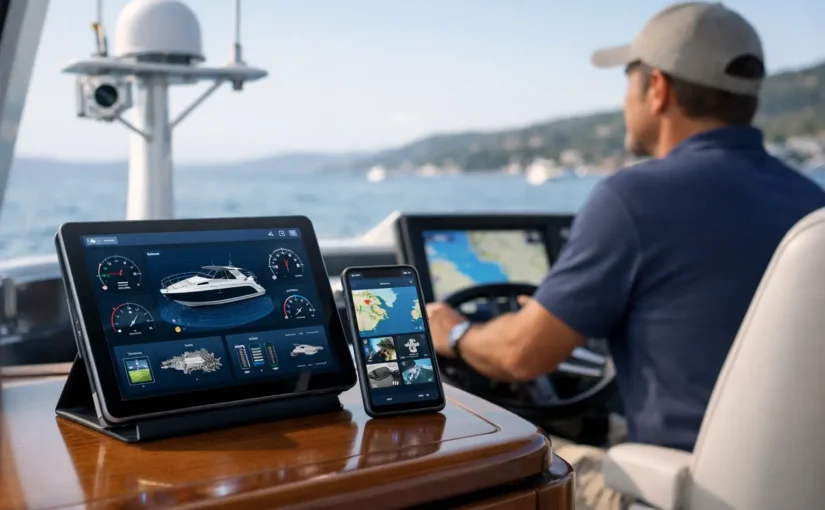
The mobile app is where monitoring either becomes useful or frustrating. A good app should show vessel status clearly at a glance. You should be able to open it and know whether shore power is present, batteries are healthy, bilge activity is normal, and the boat remains where it should be. If you have to dig through layers of menus just to confirm that the boat is safe, the product is adding friction instead of reducing stress.
Good app design also means historical context. One low-voltage alert is helpful. A visible trend is better. If battery voltage has been declining for several days, or bilge pump cycles have been increasing, that pattern changes your response. The goal is not just event reporting. It is earlier detection.
Owners with more complex vessels should also expect expandability. A center console that needs battery, bilge, and GPS oversight is one use case. A larger cruiser with engine data, tank levels, generator status, cabin climate concerns, and multiple access points is another. The monitoring platform should be able to grow with the boat rather than forcing owners to layer separate systems.
Trade-offs every review should acknowledge
No system eliminates all risk, and any honest connected boat monitoring review should say that plainly. Monitoring helps you detect problems early. It does not physically stop flooding, recharge dead batteries, or replace a failed pump. The value is in awareness and response time. That matters because early action often keeps a manageable problem from becoming a major one.
There is also a cost trade-off. A proper marine monitoring system usually combines hardware, installation, and an annual service plan. Some owners hesitate at the subscription piece. That is understandable, but it is also where real-time connectivity, cloud access, and multi-channel alerting come from. If the goal is persistent remote oversight, recurring service is part of the model. The smarter comparison is not against a one-time gadget. It is against the cost of preventable damage, lost use, emergency service calls, and insurance headaches.
Installation complexity can vary too. A small basic setup may be straightforward, while a larger vessel with NMEA2000 integration and multiple sensors requires more planning. That is not a flaw by itself. It reflects the fact that better coverage usually means deeper integration with the boat’s actual systems. For many owners, professional installation is worth it because wiring quality and sensor placement directly affect reliability.
Who gets the most value from connected monitoring
Owners who keep boats at marinas, moorings, dry storage facilities, or remote docks tend to see the clearest return. The farther you are from the vessel, and the less often you can check it physically, the more valuable real-time oversight becomes. Seasonal owners and traveling owners fit this especially well. So do multi-vessel operators who need one view across several assets.
It is also a strong fit for owners of higher-value boats with more onboard systems. The more complex the vessel, the more there is to watch and the more expensive failures become. A tripped breaker that shuts down battery charging on a simple skiff is one thing. On a larger yacht with refrigeration, climate control, networked electronics, and multiple battery banks, the consequences can stack quickly.
That said, even smaller boats benefit when they sit unattended for long stretches. Theft, battery drain, and water intrusion are not just big-boat problems. The right question is less about vessel size and more about exposure. If a problem can develop while you are away, monitoring has value.
A practical standard for evaluating systems
If you are comparing options, judge them on four points. First, can the system monitor the failures that actually cost boat owners money? Second, can it deliver alerts in ways you will reliably notice? Third, is the hardware built and installed for marine conditions? Fourth, can the platform scale from basic security to deeper vessel intelligence as your needs change?
On that standard, the strongest products look less like simple trackers and more like complete protection systems. They combine onboard sensors, a marine-grade controller, app access, dependable connectivity, and a service layer that keeps alerts moving. They are built to watch, detect, and give owners time to respond.
That is where a platform like EverWatch stands out. Its approach reflects what serious boat owners actually need: marine-specific hardware, ABYC-aligned wiring discipline, dual LTE and Wi-Fi connectivity, expandable sensors, NMEA2000 integration, and alerts sent through push, SMS, email, and phone calls. It is designed around continuous vessel oversight, not isolated features.
Final take on this connected boat monitoring review
The best system is not the one with the longest feature list. It is the one you trust when the boat is unattended and conditions turn against you. If a monitoring platform can give you early notice of shore power loss, battery trouble, high water, unauthorized movement, or environmental issues – and keep delivering that notice through dependable hardware and real alert paths – it is doing the job that matters.
Your boat does not need occasional visibility. It needs persistent watch. Choose a system that treats remote monitoring like protection, not novelty, and you will sleep a lot better when the dock lines are tied and you are miles away.


 2-Year Warranty
 30-Day Money-Back Guarantee
 U.S.-Based Support