
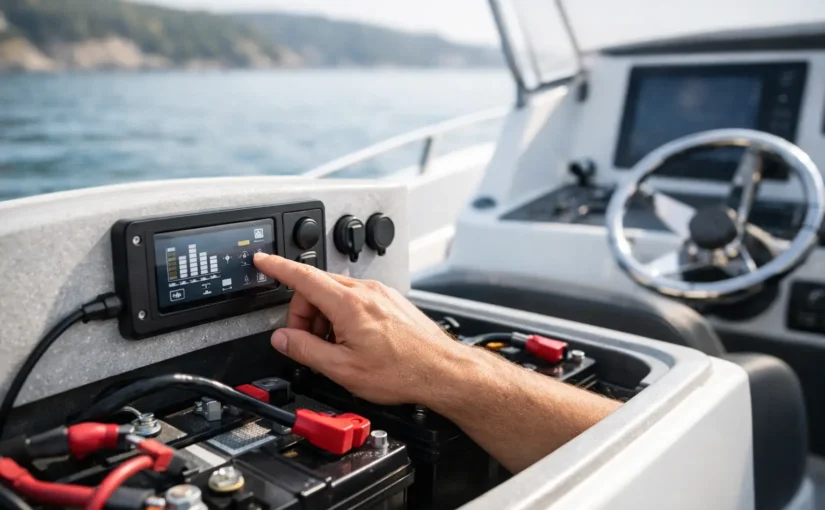
A dead battery rarely starts as a surprise. More often, it starts with a small voltage drop at the dock, a charger that stops doing its job, or a house bank that gets pulled down while nobody is aboard. That is why learning how to monitor boat batteries matters. If you want to avoid no-start conditions, spoiled trips, and expensive electrical damage, you need visibility before the bank is already flat.
What battery monitoring should actually tell you
A lot of boat owners still rely on a quick glance at a panel voltmeter or a battery switch position. That gives you a snapshot, not oversight. Real battery monitoring should answer a few simple questions at any moment: Are the batteries charging, are they holding charge, are they being drained, and did something change when the boat was left unattended?
Voltage is the first number most people watch, and it does matter. But voltage alone has limits. A resting battery voltage can suggest state of charge, yet that reading becomes less reliable if loads are active or a charger is running. On a boat with shore power connected, a healthy-looking voltage might only tell you the charger is online. It does not always tell you whether the batteries themselves are healthy.
Current draw adds the missing context. If a bank is dropping steadily overnight, current monitoring helps you see whether a bilge pump is cycling, a refrigerator is working harder than expected, or a hidden parasitic load is draining the system. Temperature matters too. Batteries do not behave the same way in summer heat, winter storage, or an enclosed engine room.
How to monitor boat batteries without guessing
The right setup depends on how you use your boat. A center console used every weekend has different needs than a yacht sitting on shore power for weeks at a time. But the core approach is the same. You need to monitor battery condition, charging status, and the events that can trigger battery loss.
Start with battery voltage, but do not stop there
A direct voltage reading is the baseline. For a 12V system, you want to know whether the bank is sitting at a healthy resting level, whether it is being charged at the proper range, and whether it is falling below your safe threshold. A slight dip is normal when loads turn on. A persistent decline is not.
Set alert thresholds based on battery type and use case. Flooded lead-acid, AGM, gel, and lithium banks all behave differently. If you set alarms too high, you will get nuisance alerts. Too low, and you find out after damage is already underway. This is one of those areas where generic consumer alarms fall short. Marine systems need thresholds that reflect real onboard conditions.
Track charging sources, not just the batteries
Many battery failures are really charging failures in disguise. Shore power drops. A charger trips offline. A solar controller underperforms. An alternator issue goes unnoticed until the next outing. If you only watch battery voltage, you may miss the reason behind the decline.
That is why strong monitoring includes the charging path. If shore power is lost at the dock, you want an alert immediately. If charger output disappears, that matters. Battery monitoring works best when it is tied to the systems that keep the bank alive.
Watch current draw when unexplained drain is the problem
If your batteries are consistently low and you do not know why, current monitoring is usually the next step. It shows whether the drain is constant or intermittent. A steady low-level draw might point to electronics left on, a faulty module, or an accessory wired directly to the bank. Intermittent spikes can suggest pumps, compressors, or cycling equipment.
This is especially useful for boats left unattended for long periods. You are not there to hear a pump run too often or notice a system that should be asleep but is still active. Data closes that gap.
The best tools for monitoring battery health on a boat
There is no single tool that fits every vessel. The best setup is usually layered.
A basic panel voltmeter is better than nothing, but it only helps if someone is onboard to see it. A handheld multimeter is accurate, but it is a spot-check tool, not continuous monitoring. A battery monitor with a shunt gives much better insight into current flow and state of charge, especially on larger house banks.
For unattended boats, remote monitoring is where the real protection starts. A connected marine monitoring system can watch battery voltage around the clock, detect shore power loss, and send alerts the moment readings move outside your safe range. That matters when your boat is in a slip, on a lift, in dry storage, or anchored without anyone nearby.
On more advanced boats, NMEA 2000 integration can add even more context. If you are already monitoring engines, tanks, and onboard systems, battery data becomes part of a wider picture instead of an isolated number. That is a better way to diagnose real problems.
Common battery problems good monitoring can catch early
Battery issues rarely happen alone. They usually connect to another onboard fault.
A failed shore power connection can leave your charger offline for hours or days. A bilge pump cycling too often can pull down the house bank and signal a leak at the same time. Corroded terminals can create voltage drop that looks like weak battery performance. Aging batteries may charge up quickly, then collapse under load. A battery switch left in the wrong position can slowly drain the wrong bank.
Monitoring helps you separate symptom from cause. If voltage drops at the same time shore power disappears, the path is obvious. If voltage falls while bilge activity increases, you are dealing with more than a battery issue. If charging voltage looks normal but the bank still cannot hold overnight, capacity loss may be the real problem.
That is the difference between reacting late and responding with purpose.
How often should you check boat batteries?
If the boat is in active use, check battery status before departure and after returning to the dock. That is the hands-on habit. But for unattended boats, manual checks are not enough. A lot can change between visits, especially during weather swings, marina outages, or long storage periods.
Continuous monitoring is the safer standard for any boat that sits connected to shore power, relies on automatic bilge pumping, or stays away from the owner for days at a time. The value is not just seeing battery data on demand. It is knowing you will be notified when conditions move outside the normal range.
That matters for seasonal owners and traveling owners most of all. If your boat is two hours away, a battery problem is no longer a small maintenance item. It becomes a timing problem. The sooner you know, the more options you have.
What to look for in a remote battery monitoring system
If you are choosing a remote setup, prioritize marine-grade hardware, dependable connectivity, and alert flexibility. Boats are hard on electronics. Moisture, vibration, corrosion, and unstable power are normal conditions. Consumer smart home gear is usually not built for that environment.
You also want a system that does more than show a battery number in an app. The strongest setups combine battery monitoring with shore power status, bilge activity, temperature, humidity, water intrusion, and location awareness. That broader view matters because battery loss is often tied to another event.
Alert delivery matters too. Push notifications are useful, but they are not always enough. SMS, email, and phone call alerts create a more reliable chain of awareness, especially for urgent conditions. If you manage more than one vessel, centralized visibility becomes even more valuable.
EverWatch Systems was built around that exact need – persistent, marine-specific oversight that helps owners catch battery issues early, along with the charging, flooding, and security events that often cause them.
The trade-offs boat owners should keep in mind
More data is not always better if it creates noise. A system that sends constant low-priority alerts can train owners to ignore the important ones. Thresholds need to be set carefully. Installation matters too. Poor wiring can create false readings or unreliable reporting, which defeats the purpose.
There is also a difference between battery monitoring for convenience and battery monitoring for protection. If you only want to know whether the bank is generally healthy before a weekend trip, a simpler setup may be enough. If you need to protect a high-value vessel left unattended at a marina, you need continuous monitoring, dependable connectivity, and alerts that reach you fast.
That is the real standard. Not just data, but early warning you can act on.
A boat battery should never fail quietly while the vessel sits alone. Monitor the bank, watch the charging sources, and treat every unexpected voltage drop as a signal worth investigating. The sooner you see the change, the easier it is to protect everything connected to it.


 2-Year Warranty
 30-Day Money-Back Guarantee
 U.S.-Based Support