
You do not find out your shore power failed when you need a jump on Saturday morning. You find out after batteries sag, refrigerators warm up, pumps cycle too often, and a small issue turns expensive. A remote boat monitoring guide starts with that reality: the real value is not convenience. It is early detection when nobody is on board.
For most owners, the risk is not one dramatic event. It is the quiet chain reaction. A leaking shaft seal triggers bilge activity. A dock pedestal trips and battery chargers go offline. A hatch is left unsecured before a storm. A boat shifts outside its slip or swings wider than expected at anchor. If you only know after the damage is visible, you are already behind.
What a remote boat monitoring guide should actually cover
A good remote boat monitoring guide should not stop at GPS tracking or a simple battery alarm. Boats fail in systems, not in isolation. If you want real oversight, you need to watch the conditions that lead to damage, theft, and downtime.
That usually starts with shore power status, battery voltage, bilge pump activity, and high-water detection. Those are the alerts that catch many of the most expensive marina and storage incidents early. From there, location awareness matters – GPS position, geofencing, and anchor status tell you if the vessel moves when it should not.
Environmental monitoring matters too, especially for stored boats and enclosed cabins. Temperature and humidity can reveal HVAC failure, freezing risk, mold conditions, or simply an open door or hatch. Security inputs add another layer. If a hatch, cabin door, or lazarette opens unexpectedly, that is not a detail. It is an event.
For more advanced owners, engine, transmission, and tank data can be just as valuable. If your boat supports NMEA2000 integration, remote visibility can extend beyond alarms into operating awareness. You can check battery state, fuel levels, engine information, and other vessel data without piecing together separate devices.
Why consumer trackers are not enough
A lot of owners start with a tracker. That makes sense if theft is the only concern. But for most unattended boats, theft is only one piece of the problem.
A consumer GPS device can tell you where the vessel is. It usually cannot tell you whether shore power dropped, whether water is rising in the bilge, whether a battery bank is collapsing, or whether a freezer circuit went dark. Even if it offers a few add-on sensors, the system is often built for cars, trailers, or general IoT use – not for a wet, vibrating, electrically complex marine environment.
That difference matters. Marine-grade hardware, proper wiring practice, and ABYC-aligned installation are not marketing details. They affect reliability, false alarms, and long-term safety. On a boat, a monitoring failure is not just annoying. It can hide the exact event you installed the system to catch.
The core elements of a boat monitoring system
Remote monitoring works best when hardware, connectivity, sensors, and alerts are designed as one system. If any one of those pieces is weak, the whole stack becomes less useful.
The onboard controller is the foundation. It gathers data from sensors, interprets conditions, and communicates status to your app. That controller needs to be built for marine duty and installed correctly. If it cannot tolerate heat, moisture, corrosion, and vibration, your confidence in the data will always be limited.
Connectivity is the next decision point. Wi-Fi-only systems may work at some marinas, but they can leave blind spots in storage yards, anchorages, and transient locations. Cellular-only systems are stronger for persistent coverage, but dual LTE and Wi-Fi can provide better flexibility. It depends on where the boat lives and how often it moves. Redundancy is not excessive when you are trying to maintain visibility away from the dock.
Sensors are where many systems separate themselves. The right setup depends on the vessel and the owner’s priorities. A center console on a lift may need a different mix than a cruiser in a slip or a yacht that spends weeks unattended. Expandable architecture matters because needs change. Owners often start with power, battery, and bilge alerts, then add intrusion, temperature, tank, or NMEA2000 data once they see the value.
Alerting is where monitoring becomes action. Push notifications are useful, but not always enough. If a high-water event occurs at 2:00 a.m., you may want SMS, email, and even a phone call until someone responds. The right escalation path depends on the severity of the issue and who else needs to know.
How to choose the right setup for your boat
Start with the failure you most want to catch early. For many marina-kept vessels, that is shore power loss. For boats on moorings or at anchor, it may be movement, anchor drag, or battery condition. For stored boats, temperature swings, humidity, and intrusion can rise to the top.
Then look at how long the boat sits unattended. If you check in every day and the boat is ten minutes away, you may be comfortable with a simpler system. If you travel often, keep the boat in another state, or manage multiple vessels, you need wider visibility and more persistent alerting.
Your tolerance for complexity matters too. Some owners want a clean mobile app, basic health data, and direct alerts. Others want deeper integration with onboard systems and a broader sensor map. Neither approach is wrong. The point is to choose a system that matches how you operate the boat.
Installation should also factor into the decision. A monitoring platform is only as good as its wiring, sensor placement, and power strategy. Ask how the system handles power interruption, what happens when connectivity drops, and how serviceable it is if you want to expand later.
Common mistakes owners make
The biggest mistake is treating monitoring like a tracker purchase instead of a vessel protection decision. A low-cost device can look adequate until you map it against actual marine risks.
Another mistake is over-focusing on one hazard while ignoring the others. Owners worried about theft sometimes skip bilge, battery, or shore power alerts, even though those issues are more likely to cause immediate damage. The reverse also happens. A boat can be mechanically healthy and still leave the dock unexpectedly.
Some owners also underestimate the value of fast alerts. Data alone does not protect the boat. The useful part is knowing soon enough to call the marina, a captain, a yard, or a nearby friend before the situation worsens.
Finally, there is the problem of disconnected tools. One app for GPS, another for batteries, another for cameras, and no unified alert logic. That patchwork can work for a while, but it often creates gaps and delays. When an issue develops, you want one view of the vessel, not a scavenger hunt.
What strong remote monitoring looks like in practice
The best systems do two things well. First, they watch the right functions continuously. Second, they make the information easy to act on.
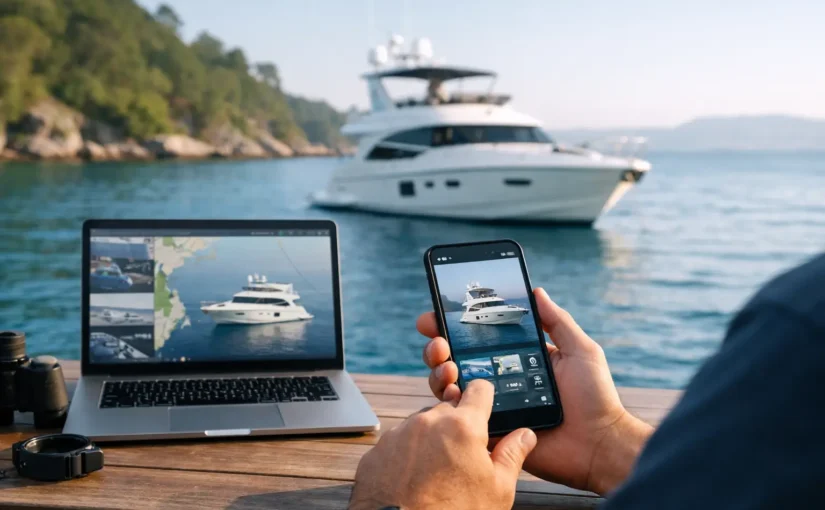
That means you can open an app and know whether the boat has power, whether batteries are healthy, whether pumps are cycling, whether the vessel is where it should be, and whether onboard conditions are stable. If a threshold is crossed, you get a clear alert through the channels you chose.
For more advanced users, integrated vessel data adds another layer of operational confidence. NMEA2000 visibility can give owners and managers a more complete picture of what is happening onboard without needing to be physically present. That is especially useful for larger boats, traveling owners, and multi-vessel operations where manual checks are inconsistent.
A platform like EverWatch is built around that broader protection model – marine-grade hardware, ABYC-aligned installation principles, dual connectivity, expandable sensors, and alert paths that fit the seriousness of the event. That combination matters because the goal is not just to know more. It is to respond sooner.
A remote boat monitoring guide is really about time
Every monitoring decision comes down to time. Time between failure and detection. Time between alert and response. Time between a minor issue and a major repair bill.
You cannot eliminate every risk on the water or at the dock. But you can close the window where problems grow unnoticed. That is what remote monitoring is for. Not gadget appeal. Not another screen to check. Just constant oversight that helps you protect the boat when you are not there to hear the pump, smell the heat, or see the dock lines shift.
Choose a system that watches the conditions that matter on your boat, communicates reliably where your boat lives, and alerts you fast enough to act. That is how remote monitoring earns its keep long before anything goes wrong.


 2-Year Warranty
 30-Day Money-Back Guarantee
 U.S.-Based Support