
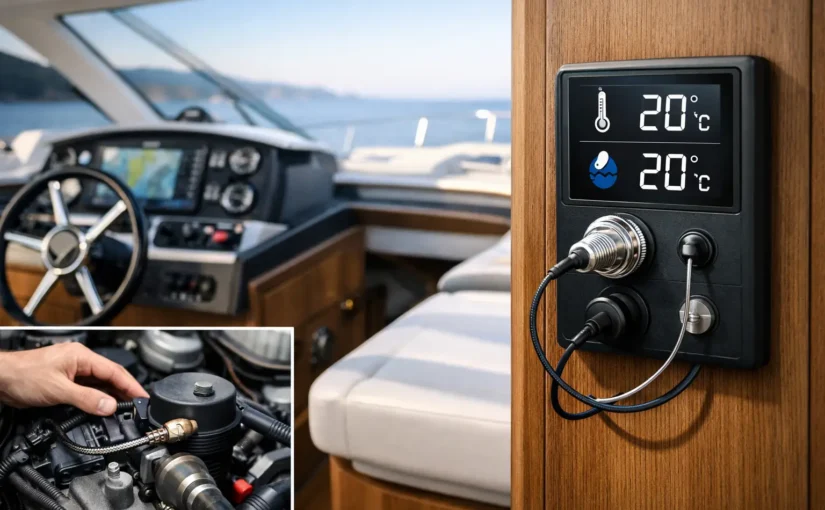
A failed heater in January and a sealed-up cabin in August can both create the same expensive surprise – damage you do not see until you step aboard. A boat temperature monitoring system closes that gap. It gives you remote visibility into onboard conditions and sends alerts before extreme heat or cold turns into dead batteries, ruined interiors, frozen plumbing, spoiled provisions, or stressed equipment.
For many owners, temperature looks like a minor data point until it is tied to a real loss. That is the mistake. On an unattended boat, temperature is often the first warning that something else has changed. Shore power may be out. HVAC may have stopped. Ventilation may have failed. A hatch may be open. In cold weather, interior temperatures can drop fast enough to threaten water systems and onboard gear. In hot weather, battery compartments, cabins, and equipment spaces can reach levels that shorten component life and push humidity higher.
What a boat temperature monitoring system actually does
At its core, a boat temperature monitoring system measures temperature in one or more onboard locations and reports that data remotely. The better systems do more than log a number. They let you set thresholds, track trends, and receive immediate alerts through the channels you will actually notice, such as push notifications, text, email, or phone call.
That difference matters. A sensor without dependable alerting is just a delayed post-mortem. Effective monitoring is about detection and response. If the temperature in your cabin drops below a safe threshold while the boat is in winter storage, you need to know then, not when you arrive two weeks later and find burst fittings. If the engine room temperature rises unexpectedly when the boat is idle, that may point to a ventilation or equipment issue worth checking before it becomes a larger fault.
A strong system also gives temperature context. Temperature alone is useful, but temperature paired with shore power status, battery condition, humidity, bilge activity, or hatch position is far more actionable. If cabin temperature is falling and shore power has dropped, the likely cause is clearer. If interior heat spikes and a door or hatch sensor shows open status, you may be dealing with a simple access issue rather than an HVAC failure.
Why temperature monitoring matters more than most owners think
Boats live in harsher conditions than homes, and they spend long periods unattended. That combination makes environmental monitoring far more valuable on the water than many owners expect.
Cold is the obvious concern in northern climates. A boat that loses heat during a freeze can suffer damage to plumbing, pumps, heads, freshwater systems, and any compartment that was assumed to be protected. Even if the boat was winterized, certain stored items and onboard electronics may still be exposed to harmful low temperatures.
Heat creates a different set of problems. Cabin materials, adhesives, electronics, batteries, food stores, and climate-sensitive gear all degrade faster under sustained high temperatures. Heat and humidity together can also accelerate mold and mildew growth, especially in enclosed cabins and storage compartments.
Then there is the middle ground – the slow, unnoticed problem. Maybe your shore power pedestal trips for a few hours at a time. Maybe your dehumidifier stops cycling normally. Maybe a battery charger is no longer supporting the system as expected. Temperature drift can reveal these issues early, long before they become obvious to the eye.
Where to place sensors on a boat
The right sensor placement depends on how you use the vessel and what you are trying to protect. One sensor in the main cabin may be enough for a small center console with a console enclosure. It is not enough for a larger cruiser, sportfish, or yacht with multiple cabins, machinery spaces, and storage areas.
Most owners should think in zones. The main cabin is the first zone because that is where HVAC-related issues are easiest to detect and where interior damage often shows up. The engine room is another high-value zone, especially on larger vessels where excess heat may indicate equipment concerns. Utility spaces, battery compartments, lazarettes, and areas near freshwater systems can also deserve coverage depending on climate and layout.
There is a trade-off here. More sensors give better visibility, but only if the system is easy to manage. If your app presents a clean view of each area and lets you assign sensible alert thresholds, multi-zone monitoring becomes useful instead of noisy. Expandable sensor architecture is a real advantage on boats because no two layouts are the same.
What to look for in a boat temperature monitoring system
Reliability matters more than novelty. Marine environments punish weak hardware. Salt air, vibration, moisture, power fluctuations, and intermittent connectivity will expose consumer-grade devices fast.
Start with marine-grade design. Hardware built for residential or garage use is a poor match for a vessel that may sit at a dock, in outdoor storage, or on a mooring through seasonal extremes. Proper installation matters too. ABYC-aligned wiring and safety practices are not marketing details. They reduce risk and help the system perform as intended over time.
Connectivity is the next major factor. A system that depends on one communication path is more vulnerable than it looks. Boats move between marinas, storage yards, and anchorages. Wi-Fi may be available one month and unreliable the next. Cellular coverage may be strong at the slip and weaker inland. Dual connectivity, using LTE and Wi-Fi, gives the system a better chance of staying online when conditions change.
Alerts are just as important as data collection. Many owners assume an app notification is enough. It often is not. If a freeze event begins overnight or while you are traveling, you may miss a single push alert. Multi-channel escalation through push, SMS, email, and phone call gives you better odds of responding in time.
For more advanced owners, integration matters. If the system can also monitor shore power, batteries, bilge activity, intrusion, and NMEA2000 vessel data, temperature stops being an isolated reading and becomes part of a complete remote oversight picture. That is where real prevention starts.
Boat temperature monitoring system vs standalone alarm
A standalone temperature alarm can help in a narrow use case. It may be enough for an owner who stores a small boat nearby and checks it often. But it has limits. Many basic alarms only sound locally, rely on short-range connectivity, or provide no historical data. They tell you there is a problem only if you are physically close enough to hear or inspect it.
A connected boat temperature monitoring system is built for absence. It assumes you are away from the vessel and still need immediate awareness. It also assumes temperature is only one part of the risk profile. That is a more realistic approach for boats that stay in the water, sit in a yard, or remain unattended for days or weeks at a time.
This is why many serious owners stop piecing together separate consumer devices. One app for a camera, another for a tracker, a different sensor for cabin temperature, and no shared alert logic between them creates blind spots. A unified marine monitoring stack reduces those blind spots and simplifies response.
When remote monitoring pays for itself
The value is not just in catastrophic saves, though those happen. It is also in catching smaller failures before they stack up. A temporary shore power loss that shuts down climate control. A battery issue that limits system uptime. An unexplained heat rise in a closed compartment. These are the kinds of events that become manageable when you know about them early.
For seasonal owners, traveling owners, and multi-vessel operators, remote temperature visibility is not a convenience feature. It is operational control. You can make a call to the marina, contact a captain, dispatch service, or ask someone to check the boat before damage spreads.
EverWatch approaches this the right way: marine-grade onboard hardware, expandable sensors, dual LTE and Wi-Fi connectivity, and alert delivery designed for actual response, not passive logging. That matters when the boat is unattended and conditions change fast.
The right system depends on your boat and your risk
A trailer boat stored close to home needs a different setup than a yacht kept in the water year-round. A boat in Florida may be more focused on heat and humidity. A boat in the Northeast may be more concerned with freeze protection. Some owners only need cabin awareness. Others want engine room, battery compartment, and machinery-space coverage tied into a larger monitoring platform.
The common thread is simple. If a temperature swing can damage something you care about, you should not be waiting to discover it in person. Remote awareness gives you time to act, and on a boat, time is usually the difference between a service call and a major repair.
Your boat does not stop facing risk when you leave the dock. The right monitoring system keeps watch when you cannot – and that is exactly when it matters most.


 2-Year Warranty
 30-Day Money-Back Guarantee
 U.S.-Based Support