
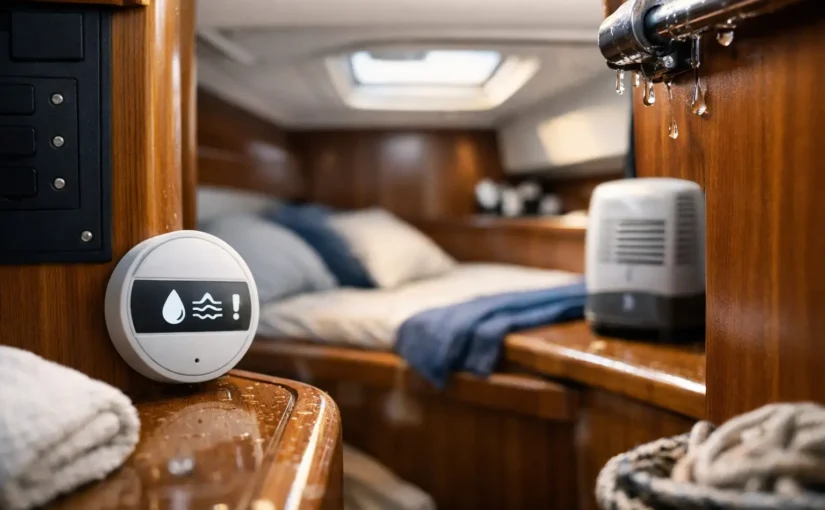
Open a cabin after two weeks away and you can smell the problem before you see it. Damp upholstery, fogged portlights, soft wood trim, and that stale air that says moisture has been building unchecked. A boat humidity sensor alert gives you an early warning before that hidden moisture turns into mold, corrosion, swollen finishes, and expensive cleanup.
Humidity sounds minor compared with high water or shore power loss. It is not. On an unattended boat, trapped moisture quietly works across fabrics, electronics, wood, fasteners, and interior spaces. By the time the cabin feels wet, the damage is often already underway.
Why a boat humidity sensor alert matters
Humidity is one of those threats that rarely arrives as a dramatic event. It builds slowly from weather swings, poor ventilation, hatch leaks, failing seals, condensation, or an air conditioning system that stopped doing its job. Boats are especially vulnerable because they live in a damp environment to begin with, and many spend long stretches closed up.
That makes humidity different from a one-time alarm. It is a trend problem. Relative humidity can stay elevated for days and create the perfect conditions for mildew, corrosion, and material breakdown. A proper alert tells you when conditions have crossed a threshold that deserves action, not just when something is already ruined.
For seasonal owners, traveling owners, and anyone with a boat sitting in a marina or storage yard, that matters. You are not standing onboard to notice the first signs. You need the system to notice for you.
What high humidity actually does onboard
The obvious risk is mold and mildew. Once moisture settles into soft goods, wall liners, cushions, and enclosed lockers, growth can spread fast. That means cleanup, odor removal, and in some cases replacement rather than repair.
The less obvious risk is corrosion. Electrical terminals, panel connections, battery areas, breakers, and electronic equipment do not need standing water to suffer. Persistent damp air accelerates oxidation and can shorten the life of systems you depend on. On a modern vessel with sensitive electronics, that is not a small issue.
Then there is the finish damage. Wood trim can swell. Adhesives can weaken. Headliners can loosen. Paper charts, manuals, and soft storage items absorb moisture. Even if the boat still runs perfectly, the interior starts aging faster than it should.
High humidity can also point to another failure you would rather catch early. It may signal a hidden leak, a hatch left cracked open, a failed cabin dehumidifier, or air conditioning that has stopped cycling. In that sense, the alert is not just about damp air. It is a clue that another onboard system may need attention.
When a boat humidity sensor alert should trigger
There is no single perfect humidity number for every vessel. It depends on climate, season, storage conditions, and whether the boat is occupied. A boat in Florida during summer will live in very different ambient conditions than a shrink-wrapped boat in the Northeast.
That said, many boat owners start paying close attention when interior humidity stays above 60 percent for sustained periods. Above that range, the chance of mildew and condensation problems rises. If readings climb toward 70 percent and stay there, the risk becomes much more immediate.
This is why fixed alarms without context can be frustrating. A useful system should help you distinguish between a temporary weather-driven rise and a sustained onboard condition that needs intervention. Alerts should support action, not create noise.
Boat humidity sensor alert vs. basic temperature monitoring
Some owners assume cabin temperature alerts are enough. They help, but they do not tell the full story. A cool cabin can still be damp. A warm cabin can still be dry enough to avoid trouble. Temperature and humidity work together, and if you are only watching one, you are missing part of the picture.
For example, a failed air conditioning unit may show up as a rising cabin temperature. But if the humidity spikes first, that may be your earliest sign. The same goes for poor ventilation after weather changes. The cabin may not get dangerously hot, but moisture can still collect on surfaces and inside enclosed compartments.
The most practical approach is to monitor humidity as its own condition while viewing it alongside temperature and other sensor data. That gives you a better read on what is happening onboard and what kind of response makes sense.
Where humidity sensors work best on a boat
Placement matters. A humidity sensor mounted in a well-ventilated area near an open companionway may underreport what is happening in a sealed stateroom, cabinet, or lower cabin. On the other hand, a sensor placed too close to a vent or direct moisture source may overreact to a localized condition.
In most boats, the best location is an interior living space where air conditions represent the broader cabin environment. On larger vessels or boats with known moisture trouble in specific zones, multiple sensors may make more sense. One sensor can watch the main salon, while another keeps an eye on an enclosed cabin, machinery-adjacent space, or storage compartment.
This is where expandable monitoring architecture matters. Not every vessel has the same risk profile. A center console with a console compartment has different needs than a sedan bridge, cruiser, or yacht with multiple interior zones.
What happens after the alert matters most
A boat humidity sensor alert only creates value if it gets to you quickly and clearly. If the notice is delayed, buried, or limited to a single channel, you may not see it until the problem has grown. Boat owners who leave vessels unattended need more than a local alarm sounding in an empty slip.
The stronger setup is one that pushes alerts through the app and can escalate through SMS, email, and phone call paths when needed. That gives you a much better chance of seeing the issue in time to act. If you manage multiple boats, alert visibility becomes even more important because small environmental issues can be missed when they are spread across several locations.
Just as important is remote context. If you get a humidity alert, you want to check other conditions right away. Is shore power still present? Did cabin temperature rise too? Is battery voltage stable? Did a door or hatch sensor trigger? Looking at these signals together turns an alert into a decision.
Common causes behind a humidity alert
Sometimes the cause is simple. A hatch gasket is leaking during rain. A porthole was not dogged down fully. The dehumidifier reservoir filled up and shut off. A climate control unit lost power. In storage, shrink wrap ventilation may be inadequate.
Other times, the alert points to a more serious maintenance issue. Water may be entering through deck hardware, window seals, or an unnoticed plumbing leak. Condensation can also build in poorly ventilated areas and migrate into adjacent spaces.
The value of early detection is that you can respond while the fix is still manageable. Ask the marina to inspect the cabin. Have a captain or service tech check HVAC operation. Confirm shore power status. Open ventilation if conditions allow. Small steps taken early can stop larger interior damage from developing.
Why marine-grade monitoring matters here
Generic home sensors are tempting, but boats are not houses. Connectivity is less predictable, power conditions vary, and the environment is harsher. Salt air, vibration, heat, and damp conditions can expose the limits of consumer gear quickly.
Marine monitoring should be built for vessel conditions, installed with proper wiring practices, and designed to keep reporting when the boat is unattended for long periods. That means dependable onboard hardware, stable communications, and sensor options that fit how boats are actually used. It also means the humidity alert should be part of a larger protection system, not an isolated gadget.
That broader view is where a platform like EverWatch makes practical sense. Humidity becomes one layer of defense alongside shore power, battery health, bilge activity, intrusion, temperature, GPS, and other critical vessel data. You are not just getting a warning about damp air. You are gaining remote awareness of the conditions that may be causing it.
Who benefits most from a boat humidity sensor alert
Any unattended boat can benefit, but some owners have more exposure than others. Boats in humid coastal climates, vessels with enclosed cabins, seasonal boats sitting for weeks at a time, and yachts with extensive interior finishes all face higher risk. Owners who travel often or keep boats in remote slips also gain more from remote environmental monitoring because they cannot easily check conditions in person.
If your boat has already had mildew, corrosion, or recurring cabin moisture, a humidity alert is not a nice extra. It is a control measure. It helps you stop guessing and start monitoring the actual conditions that lead to damage.
A boat does not have to be taking on water to be in trouble. Sometimes the first threat is the moisture hanging in the air, working slowly while no one is aboard. Catch that early, and you protect a lot more than cabin comfort.


 2-Year Warranty
 30-Day Money-Back Guarantee
 U.S.-Based Support