You do not find out your engine has a problem when you are standing calmly at the dock with a coffee in hand. You find out when a trip gets cut short, a battery bank drops lower than expected, or a small fault starts stacking into a much bigger repair bill. That is why a boat engine data app matters. It is not just a digital gauge screen. It is a way to see what your vessel is doing when you are onboard and, just as important, when you are not.
For many owners, the mistake is assuming engine data alone is enough. It is useful, but by itself it is incomplete. A serious marine monitoring setup needs to connect engine information with power status, tank levels, bilge activity, GPS position, and immediate alerts. If you only see RPM and temperature, you are watching one part of the story. Boat protection requires the full picture.
A boat engine data app should do more than mirror gauges
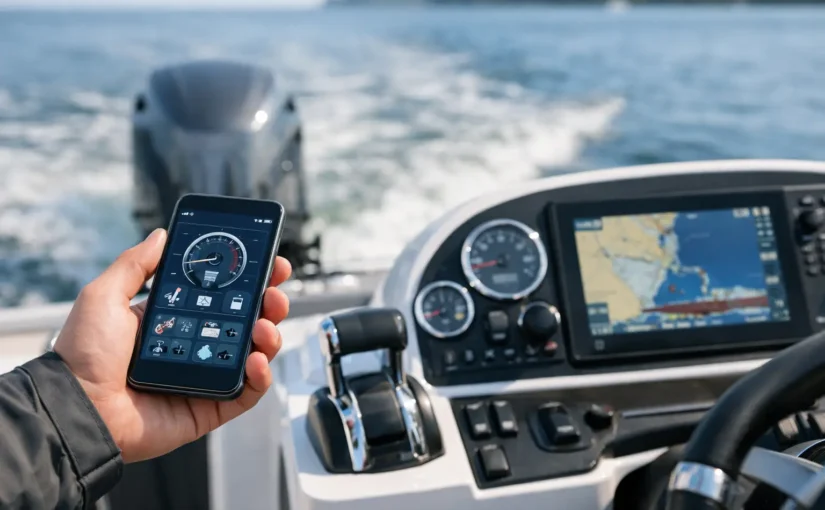
A basic app can pull NMEA2000 engine values and display them on a phone. That sounds good on paper. In practice, it may not help much if it simply repeats what your helm already shows.
The better question is this: what can the app tell you that changes your decisions? If it shows engine hours, coolant temperature, oil pressure, fuel rate, voltage, and fault conditions in a way you can check remotely or review later, now it starts becoming operationally useful. If it can warn you when values move outside normal ranges, it becomes protective.
That distinction matters for owners who leave boats in slips, dry storage, or at anchor for days or weeks at a time. A vessel is exposed even when the engines are off. Shore power can fail. Batteries can sag. Water can enter. Temperatures can climb. Unauthorized movement can happen. An engine data app that lives in isolation will not catch those events.
The most useful engine data is the data tied to action
Not every data point deserves equal attention. Some values look impressive in an app demo but do very little in the real world. Others can save you from expensive damage if they trigger fast enough.
Engine temperature is one example. Seeing a live number is helpful, but seeing that number with alert thresholds and historical context is far more valuable. The same goes for oil pressure, alternator output, fuel flow, and engine voltage. One reading might not mean much on its own. A trend, a sudden change, or an alert tied to a threshold tells you when to act.
Engine hours are also more valuable than they first appear. They support maintenance planning, help verify usage across multiple vessels, and give owners a clearer picture of service intervals. If you manage a larger boat or a small fleet, that visibility is not a convenience. It is part of protecting equipment life.
Fuel and tank data belong in the same conversation. An engine does not operate independently from the fuel supply, and owners should not have to switch between disconnected systems just to understand range, burn, or tank status. Good monitoring keeps those values in one place so you can spot inconsistencies early.
Why remote visibility changes the value of a boat engine data app
The biggest shift in recent years is not that boats can generate more data. It is that owners now expect to see critical data without being physically onboard. That is a reasonable expectation, especially for high-value boats left unattended at marinas, yards, or moorings.
But remote visibility only works if the system behind the app is built for marine use. Consumer trackers and generic IoT devices often fail at the exact moment a boater needs certainty. Connectivity drops. Sensors are limited. Alerts are delayed or too narrow. Hardware is not designed for wet, corrosive environments. That is where many app-first solutions fall short.
A dependable setup needs marine-grade hardware, stable communications, and the ability to keep reporting through real-world dockside conditions. Dual LTE and Wi-Fi connectivity, properly installed sensors, and ABYC-aligned wiring matter because reliability is not a software feature alone. It starts with the physical system onboard.
The right app connects engine data to boat protection
A strong boat engine data app should be part of a broader monitoring platform. That means engine data is not trapped in its own tab, disconnected from the rest of the vessel. Instead, it works alongside alerts for shore power, battery health, high water, intrusion, hatch status, anchor movement, and location.
That is the difference between information and oversight.
If your app shows engine voltage dropping while shore power has also failed, that tells you more than either alert would on its own. If rising humidity appears alongside an open hatch event, you have context. If the boat moves outside a geofence and engine data becomes active, you may be dealing with theft or unauthorized use rather than a harmless dockside event.
Owners want one source of truth. They do not want to piece together engine telemetry from one app, battery data from another, and GPS movement from a third. Fragmented monitoring creates delay, and delay raises the cost of every preventable problem.
What to look for in a boat engine data app
The best apps are clear, fast, and practical. They do not bury urgent conditions under flashy dashboards. They show what matters first.
For most owners, that starts with live engine values, engine hours, transmission data where available, and tank information through NMEA2000 integration. It should also include alerting that reaches you in more than one way. Push notifications are useful, but they should not be your only option. SMS, email, and phone call escalation can matter when a boat is unattended and the issue is urgent.
Historical visibility matters too. A one-time reading is often less useful than a trend line. Maybe a battery supports normal loads for weeks, then suddenly declines after a shore power issue. Maybe one engine consistently runs hotter than the other under similar load. Maybe fuel usage no longer matches your normal pattern. Historical data helps separate a real issue from a one-off fluctuation.
Usability matters just as much as feature count. A crowded interface can make a capable app feel unreliable. Boat owners need to open the app and understand vessel status in seconds. Green means normal. Alerts stand out. Device names are clear. Sensor categories are obvious. If the app requires too much interpretation, response time suffers.
Where simple engine apps fall short
There is a trade-off here. A simple app that only displays engine metrics may cost less upfront or feel easier to install. For some owners who only want another view of helm data while underway, that may be enough.
But most unattended-boat risk does not come from a lack of RPM visibility. It comes from the events around the engine room and electrical system. Shore power loss, battery drain, water intrusion, bilge cycling, and unexpected vessel movement cause real damage, and they often happen while nobody is onboard.
That is why the smartest buyers do not ask only, “Can this app show engine data?” They ask, “Can this system help me respond before damage spreads?”
That is a higher standard, and it should be. Boats are complex systems. Monitoring should reflect that complexity without making the owner work harder.
Why NMEA2000 integration is only part of the answer
NMEA2000 integration is a major advantage because it gives owners access to engine, transmission, and tank data already moving across the vessel network. For technically minded boaters, that is essential. It reduces duplication and opens up better visibility across key onboard systems.
Still, integration alone is not the finish line. You need clean data presentation, dependable alerting, and a monitoring platform that continues working when the boat is unattended. If the app can read network data but cannot notify you quickly when something goes wrong, the value drops fast.
This is where a purpose-built monitoring platform stands apart. EverWatch approaches engine data as one part of continuous vessel oversight, not as a standalone gadget feature. That means owners can see critical NMEA2000 values while also keeping watch over shore power, batteries, bilge activity, position, security, and environmental conditions from the same mobile experience.
The best app is the one that helps you act early
Boat ownership gets expensive when problems stay hidden. Small issues rarely stay small on the water. A useful boat engine data app gives you awareness, but a better one gives you time. Time to call the marina. Time to send a technician. Time to shut down a risk before it turns into damage, downtime, or a missed season.
That is the real standard. Not how many gauges fit on a screen, but how quickly you can understand what is happening and what needs attention.
If you are evaluating options, look past the dashboard screenshots. Ask whether the system is built for remote protection, whether the alerts are strong enough to reach you, and whether engine data is connected to the rest of the boat. When your vessel is out of sight, the app should not just inform you. It should keep watch.


 2-Year Warranty
 30-Day Money-Back Guarantee
 U.S.-Based Support