
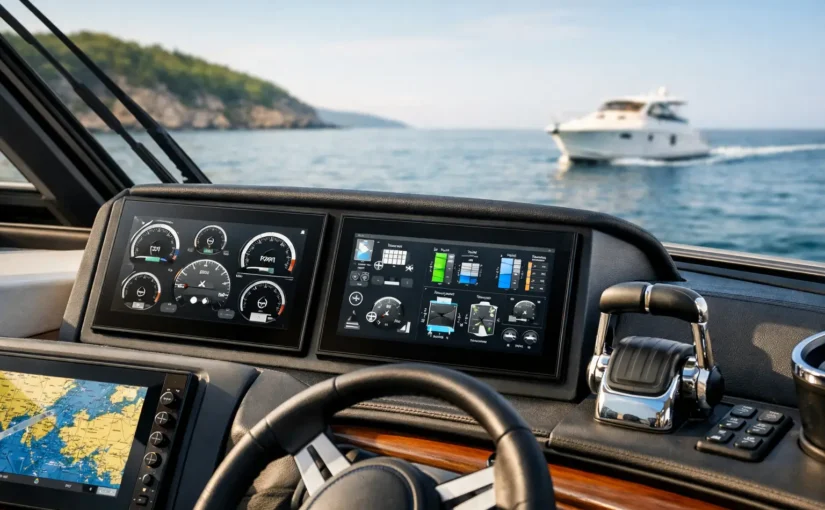
A dead battery bank rarely starts as a dramatic failure. More often, it begins with a small charging issue, a shore power interruption, or a load that stayed on too long while the boat sat unattended. That is where nmea 2000 boat monitoring earns its place. It turns the vessel network into usable oversight, giving you visibility into engines, tanks, electrical data, and operating status before a small problem becomes an expensive service call.
For owners who leave a boat in a slip, on a lift, in dry storage, or on a mooring, the value is straightforward. You cannot stand watch all day. Your monitoring system can. When NMEA 2000 data is combined with dedicated sensors for bilge, battery health, shore power, temperature, humidity, intrusion, and location, you get a much clearer picture of what is happening onboard even when you are miles away.
What NMEA 2000 boat monitoring actually gives you
NMEA 2000 is the vessel data backbone on many modern boats. It allows compatible devices to share information across a common network. Depending on the equipment installed, that can include engine RPM, coolant temperature, oil pressure, fuel rate, transmission data, tank levels, water temperature, rudder angle, GPS position, and more.
On its own, that network is useful at the helm. The real advantage comes when nmea 2000 boat monitoring extends that data beyond the boat and into a remote app with alerts. Instead of checking systems only when you are onboard, you can see changing conditions while the boat is unattended. If a battery voltage trend starts dropping, if a tank reading looks wrong, or if engine data indicates a fault after a captain or yard run, you know quickly.
That matters because many expensive marine failures are not caused by a total lack of information. They are caused by delayed awareness. The issue sits unnoticed for hours, days, or weeks.
Why NMEA 2000 data alone is not enough
Some owners assume that if they already have multifunction displays and NMEA 2000 devices, they already have a monitoring system. Usually, they do not. They have local visibility. That is not the same thing as persistent remote protection.
A chartplotter can show engine and tank data when you are standing at the helm. It typically will not protect the boat while you are at home, on a flight, or away for the season. It also may not alert you through push, SMS, email, or phone call when a condition changes. And it usually does not cover non-NMEA threats such as water intrusion in a cabin space, shore power loss at the pedestal, a bilge pump cycling too often, or a hatch opening after hours.
This is the trade-off boaters should understand clearly. NMEA 2000 is a powerful source of onboard data, but remote protection requires more than network access. It requires a monitoring platform built for unattended vessels, reliable connectivity, a dedicated alert strategy, and marine-grade hardware that belongs in a boat, not in a garage project.
The most useful data to monitor remotely
Not every PGN on a network has equal value when the boat is sitting still. The best nmea 2000 boat monitoring setups focus on the data that helps prevent damage, confirms vessel status, or shortens troubleshooting.
Engine and transmission data can be valuable for owners who want verification after service work, captain use, or sea trials. Tank data matters when you are tracking fuel, fresh water, waste capacity, or unexpected changes that may point to sensor or system issues. Battery and charging information is often even more critical, especially on boats that depend on shore power, chargers, inverters, and house banks staying healthy between visits.
Still, there is an important practical point here. A boat at the dock is not protected just because you can see RPM and tank percentage. The higher-value protections often come from pairing vessel network data with direct alarm conditions such as high water, shore power interruption, battery voltage thresholds, temperature swings, humidity spikes, and unauthorized movement.
How a complete monitoring stack works
The most effective setup combines three layers. First, it reads the boat’s NMEA 2000 network. Second, it adds dedicated sensors for risks that the network does not cover well. Third, it sends alerts off the vessel through dependable communications such as LTE and Wi-Fi.
That structure matters because boats fail in different ways. A network can report engine hours and tank levels, but it may not tell you that the cabin is overheating, that the bilge pump is short cycling, or that shore power dropped overnight. Dedicated sensors close those gaps. Off-boat connectivity closes the final one by making sure you hear about it.
This is also where product quality separates itself quickly. Marine monitoring hardware needs to handle vibration, corrosion, heat, moisture, and the odd electrical realities of life onboard. Wiring practices matter. ABYC-aligned installation matters. Alert delivery matters. If the system cannot be trusted when you are away, the feature list does not mean much.
Who benefits most from NMEA 2000 boat monitoring
The answer is broader than many people think. Yacht owners with complex systems benefit, of course, but so do center console owners, sportfish operators, cruisers, sailboat owners, and fleets managing multiple vessels.
If your boat sits unattended for meaningful stretches, remote visibility has real value. Seasonal owners use it to keep watch through weather swings and storage periods. Traveling owners use it to stay informed between marina visits. Multi-vessel operators use it to reduce blind spots across a fleet. Even hands-on owners who do most of their own maintenance benefit because the app gives them a head start before they arrive with tools in hand.
The return is not just convenience. It is faster response. A shore power outage caught in minutes is different from one discovered days later. A rising bilge condition caught early is different from a submerged battery compartment. Early awareness changes outcomes.
What to look for in an NMEA 2000 monitoring system
Compatibility is the first checkpoint, but it should not be the only one. Many buyers focus on whether the platform can read NMEA 2000 data and stop there. That is necessary, not sufficient.
Look at how alerts are handled. If the system only logs data but does not escalate notifications reliably, you may still miss a critical event. Look at connectivity options. Marina Wi-Fi can be unpredictable, so dual-path communication has practical value. Look at sensor expansion. Boats change over time, and a fixed system can become limiting fast.
Also pay attention to installation quality and support. A boat monitoring platform is not a novelty device. It sits inside a larger electrical and systems environment where bad wiring decisions create real problems. A marine-grade, ABYC-conscious approach is worth paying for because it reduces the chance that the monitoring system becomes another thing to troubleshoot.
For owners who want both technical depth and app simplicity, this balance is key. You should be able to see NMEA 2000 data when it matters without needing to babysit the system or decode a maze of settings every time you open the app.
The practical limit of NMEA 2000 monitoring
It helps to be clear about what this technology can and cannot do. It can provide valuable visibility into onboard systems and trigger early warnings. It can help confirm normal operation, identify developing issues, and reduce guesswork. It cannot physically stop every failure.
If a raw water hose lets go, a charger fails internally, or a marina pedestal loses power, monitoring does not replace repair. What it does is cut down the time between event and response. That time window is often the difference between a manageable fix and a major loss.
This is why the strongest systems are built around watchfulness, not just data display. A connected platform such as EverWatch makes sense when it treats NMEA 2000 as one part of a larger protective system that watches electrical health, water intrusion, vessel movement, environment, and onboard status around the clock.
For most boat owners, the question is not whether more data sounds nice. It is whether delayed awareness is costing them money, risk, and peace of mind. If your boat spends days or weeks without you aboard, better visibility is not a luxury feature. It is a smarter way to stand watch when you cannot be there yourself.


 2-Year Warranty
 30-Day Money-Back Guarantee
 U.S.-Based Support