
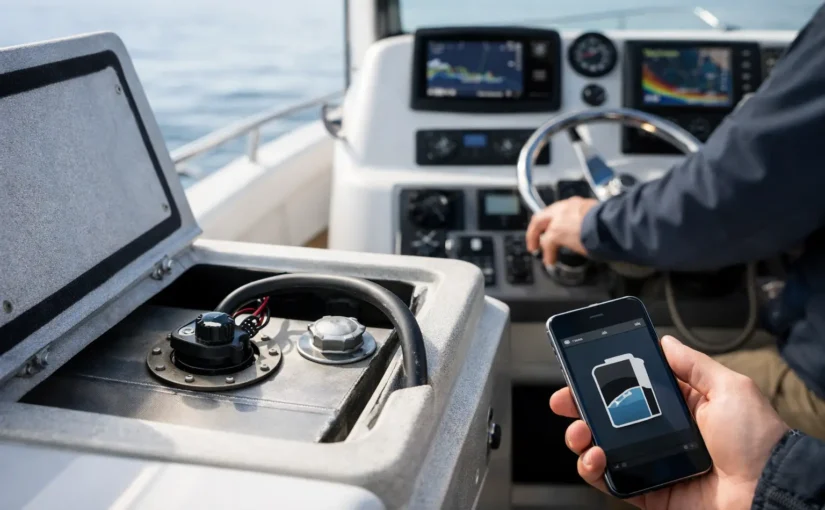
A fuel gauge that reads half full at the dock and nearly empty offshore is not a small inconvenience. It is how trips get cut short, fuel problems get missed, and expensive boats sit vulnerable without anyone knowing. Boat fuel tank monitoring solves that by turning one of the least trusted readings on board into something you can actually watch, verify, and act on.
For many owners, fuel is still managed the old way – glance at the helm gauge, estimate burn, and hope the sender is telling the truth. That approach works until it does not. Tank geometry, sender drift, wiring faults, theft, and simple inattention all create blind spots. If your boat stays at a marina, mooring, storage yard, or anchorage for days or weeks at a time, those blind spots get bigger.
What boat fuel tank monitoring actually does
At its core, boat fuel tank monitoring gives you visibility into fuel level trends instead of a single momentary reading. The best systems collect tank data from onboard sensors or NMEA2000 networks, send that information off the vessel through cellular or Wi-Fi connectivity, and make it available in a mobile app. That means you can check fuel status when you are away, not just when you are standing at the helm.
That shift matters more than most owners expect. Fuel level is not just about planning your next run. It can reveal leaks, sender issues, theft, or unexpected usage from generators and other onboard systems. When you can see what changed and when it changed, troubleshooting gets faster and the risk window gets smaller.
A connected system also changes the speed of response. If fuel data drops in a way that does not match how the boat is being used, an alert can push that issue to you right away. You are no longer finding out at the dock a week later.
Why remote fuel visibility matters when the boat is unattended
Most serious vessel problems get worse in silence. Shore power fails. Batteries drain. Bilge pumps cycle too often. Water enters where it should not. Fuel issues fit the same pattern. When nobody is on board, a small problem can become a major one simply because no one saw the first sign.
Remote boat fuel tank monitoring gives owners another layer of oversight during those unattended periods. If a tank level changes while the boat should be idle, that deserves attention. Sometimes the explanation is harmless. A generator may have run longer than expected. A calibration may be off. But sometimes the cause is exactly the kind of problem owners want to catch early – fuel loss, unauthorized use, or a developing system fault.
This is especially relevant for seasonal owners and multi-vessel operators. When you cannot physically inspect every boat as often as you would like, remote data becomes part of normal vessel protection, not a nice extra.
The limits of standard fuel gauges
Most boat owners already know helm fuel gauges can be unreliable. The reasons are practical, not mysterious. Marine tanks are rarely perfect rectangles, so fuel level does not always map cleanly to usable gallons. Mechanical float senders can stick. Wiring can degrade in wet, corrosive environments. Analog gauges can dampen or distort what the sender is trying to report.
Even when the gauge is technically working, the information may still be incomplete. A glance at the dash tells you current level, but not whether the tank has been steadily dropping over several days. It does not tell you whether a sudden change happened at 2:00 a.m. while the boat sat tied up. It does not tell you whether the reading is supported by broader vessel data.
That is where a monitored system has an advantage. It adds history, context, and off-boat access. For owners who already rely on mobile alerts for battery voltage, bilge activity, shore power, and GPS position, fuel data fits naturally into the same protection strategy.
What to look for in a boat fuel tank monitoring system
The first requirement is dependable data capture. If your vessel already uses NMEA2000, integration can be a clean way to bring tank information into a broader monitoring platform. If not, direct sensor options may be the better fit. Either way, marine-grade installation matters. Fuel data is only useful if the underlying hardware, wiring, and connections are designed for the environment and installed to proper marine standards.
The second requirement is reliable communications. A monitoring system that only works when the boat is on local Wi-Fi is limited. Boats move. Marinas have dead zones. Storage yards are inconsistent. Dual-path connectivity, typically LTE and Wi-Fi, gives you a much better chance of keeping visibility when conditions change.
The third requirement is actionable alerts. Raw data is not enough. Owners need to know when a change crosses the line from normal variation to something worth checking. Alert delivery should be immediate and flexible, with push notifications at minimum and stronger escalation options such as SMS, email, and phone call alerts when the event is serious.
The fourth requirement is context. Fuel readings become more valuable when they sit alongside battery status, shore power state, bilge activity, water intrusion, GPS location, and other vessel conditions. A single alert is useful. A system view of the boat is better.
Fuel monitoring is not just for trip planning
It is easy to think of fuel monitoring as a convenience feature for route planning. It does help there. Accurate tank visibility reduces guesswork before departure and helps owners verify consumption over time. But the bigger value often shows up while the boat is not moving.
If fuel level drops unexpectedly at the dock, that can point to unauthorized use. If readings behave erratically, that may expose a sender or wiring issue before it becomes a bigger operational problem. If tank data does not line up with engine hours or generator usage, that is a clue worth investigating. Good monitoring turns fuel from a rough estimate into part of your vessel’s broader health picture.
For larger boats and fleets, that matters even more. Operators managing multiple vessels need consistency. They cannot rely on manual checks and scattered notes. Centralized visibility helps them catch anomalies early and plan service with better information.
Trade-offs owners should understand
No fuel monitoring system is magic. Accuracy depends on sender quality, tank shape, calibration, and network integrity. A connected app cannot fix a failing sender by itself. It can, however, expose inconsistent behavior faster than occasional manual checks.
There is also a difference between seeing level and understanding usable fuel. Some boats have tank designs that make the top half and bottom half behave very differently on the gauge. In those cases, the best setup combines monitored level data with known burn rates and practical operating experience. It depends on the vessel.
Installation quality is another dividing line. Consumer-grade devices may look cheaper upfront, but marine environments punish weak connectors, poor enclosures, and casual wiring. Fuel monitoring should be part of a serious onboard system, not an improvised gadget stack.
Why integrated monitoring is the better long-term choice
Owners rarely stop at wanting fuel data alone. Once you have experienced a dead battery, lost shore power, a stuck bilge pump, or unexpected boat movement, you start thinking in systems. That is the right mindset. Boat protection works best when the vessel is watched as a whole.
An integrated platform can combine boat fuel tank monitoring with the alerts that matter most when you are away: power loss, battery health, high water, bilge activity, temperature, humidity, GPS position, and more. If your boat supports NMEA2000 data, tank information can become part of a wider operating picture rather than a standalone reading with no context.
That is where a purpose-built marine platform earns its keep. EverWatch, for example, is built around continuous remote oversight with marine-grade hardware, ABYC-aligned installation practices, app visibility, and immediate multi-channel alerts. For owners protecting valuable vessels, that kind of connected monitoring is less about gadget appeal and more about reducing risk.
When fuel monitoring makes the most sense
If you trailer a small boat and use it every weekend, fuel monitoring may be mostly a convenience feature. If your boat lives in a slip, sits in storage for stretches, runs a generator, carries substantial fuel capacity, or stays unattended for long periods, the value rises quickly.
It also makes sense for owners who do not fully trust their current gauge readings, are already using NMEA2000 electronics, or want one app that shows the condition of the boat before they leave home. The more expensive the downtime, missed trip, or avoidable service visit, the stronger the case becomes.
Fuel problems rarely announce themselves politely. They show up as bad readings, bad timing, and expensive surprises. Better monitoring gives you a chance to catch the signal early, while it is still small enough to control.


 2-Year Warranty
 30-Day Money-Back Guarantee
 U.S.-Based Support