
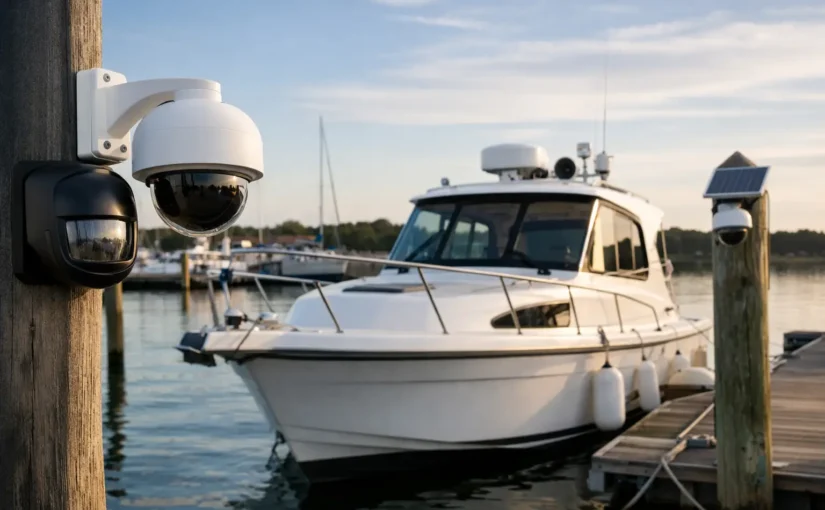
A boat rarely fails when you are standing on the dock looking at it. Problems start at 2:13 a.m., in bad weather, after a shore power breaker trips, when a bilge pump cycles too long, or when someone opens a hatch that should stay closed. That is why the best system for unattended boat protection is not just an alarm. It is a full remote monitoring system built for marine conditions, designed to detect trouble early and alert you fast enough to act.
What the best system for unattended boat protection really needs to do
If a boat is left at a slip, on a mooring, in dry storage, or at anchor for days or weeks at a time, protection has to go beyond theft tracking. Most expensive losses start with ordinary system failures. Shore power drops. Batteries discharge. Water enters where it should not. Cabin heat spikes. Freezing temperatures hit. A pump runs too often. Those are the events that turn into dead batteries, flooded bilges, spoiled interiors, corrosion, and insurance claims.
The best system for unattended boat protection watches those conditions continuously and sends immediate alerts through more than one channel. A notification buried in a phone app is not enough if the event is serious. Push alerts matter, but so do text messages, emails, and phone calls when a situation needs fast attention.
Just as important, the system has to be built for a boat. Marine electrical environments are noisy. Moisture is constant. Connectivity changes from marina Wi-Fi to cellular coverage to complete signal dead zones. A consumer smart home sensor taped inside a cabin may look inexpensive on day one, but it is usually the wrong tool for long-term vessel protection.
The difference between tracking and protection
A lot of boat owners start with GPS because theft is easy to picture. GPS is useful, but location alone does not protect a vessel from the most common unattended failures. If a shore power pedestal fails on Friday and your batteries are flat by Sunday, GPS never tells that story. If freshwater intrusion starts around a hatch and humidity builds for a week, a tracker is silent. If the bilge pump is cycling every ten minutes, you need that alert before the water rises, not after the boat moves off its normal position.
Real unattended protection combines security monitoring with systems monitoring. That means GPS position and geofencing should sit alongside shore power status, battery voltage, bilge activity, high water detection, temperature, humidity, and entry sensors for doors and hatches. For more advanced boats, it should also include NMEA2000 data such as engine information, transmission status, and tank levels.
That combination is what turns a monitoring product into a protection system.
Why pieced-together devices usually fall short
Some owners try to build their own setup using a tracker from one company, battery sensors from another, a Wi-Fi camera, and a few generic smart sensors. On paper, that sounds flexible. In practice, it creates blind spots.
Each device has its own app, power requirements, alert rules, and connectivity limits. One runs on Bluetooth. Another needs house Wi-Fi. Another sends only app notifications. None of them are designed around ABYC-aligned installation practices or the realities of marine vibration, corrosion, and intermittent power. When something goes wrong, you are not checking one system. You are checking four systems and hoping at least one is online.
There is also the issue of escalation. A serious event should not depend on whether you happened to notice a single push alert while boarding a flight or sleeping through the night. A marine-specific monitoring platform should be able to deliver layered notifications so critical conditions do not sit unseen.
The core features that matter most
The right system starts with power awareness. Shore power loss is one of the most common triggers behind larger problems. Once chargers stop, batteries begin to carry the load. If that condition goes unnoticed, you can quickly end up with low-voltage shutdowns, dead bilge pumps, and engine starting issues.
Bilge and water monitoring are next. A high-water sensor matters, but bilge cycle monitoring is often the earlier warning. If the pump starts running more often than normal, something changed. Catching that pattern early can prevent a sinking event instead of merely documenting it.
Battery monitoring needs to show more than a simple on-off state. Voltage trends tell you whether charging is healthy, whether parasitic draw is increasing, and whether a bank is holding as it should. For owners who leave refrigeration, security devices, or onboard electronics active, that visibility is essential.
Environmental monitoring also deserves more respect than it usually gets. Cabin temperature and humidity can signal HVAC failure, freezing risk, mold conditions, or electronics stress. For boats with stored gear, soft goods, or climate-sensitive interiors, those alerts are not optional.
Then there is intrusion and movement. Doors, hatches, GPS position, anchor status, and geofencing all matter, especially for boats in shared marinas or remote anchorages. But the best setup does not treat these as standalone theft features. It ties them into the broader picture of vessel status.
Connectivity is not a side detail
A monitoring system only protects what it can report. That makes connectivity one of the most important buying criteria.
Wi-Fi-only systems can work in limited situations, usually when the boat stays in a marina with stable network coverage and the owner understands that marina internet is often the weakest link. Cellular-only systems are stronger for independence, but there are still cases where local Wi-Fi support adds redundancy and lowers dependence on a single path.
The best system for unattended boat protection should account for real marina conditions, not ideal ones. Dual-path communication using LTE and Wi-Fi gives you better odds of staying connected when one network becomes unreliable. That matters most when weather is bad, power is unstable, or the boat is unattended for extended periods.
Installation quality matters more than most owners expect
A smart feature list means very little if the hardware is not installed correctly. Boat owners should look for marine-grade components and wiring practices that align with recognized marine safety standards. This is not just a technical preference. Bad installations create false alerts, sensor failures, corrosion points, and power issues that make the monitoring system less trustworthy.
Expandable architecture matters too. A center-console used for day trips may start with battery, GPS, and bilge monitoring. A larger cruiser may need shore power, climate, hatch sensors, tank data, and engine visibility. The right platform should scale with the vessel instead of forcing a complete replacement when your monitoring needs grow.
This is where a dedicated marine platform separates itself from generic IoT products. It is built around vessel systems, vessel power, and vessel failure modes.
What a serious buyer should compare
When owners ask what system is best, the answer depends on the boat and how it is used. A trailer boat stored near home has different risks than a yacht left in a hurricane-prone marina, and both differ from a vessel sitting on anchor for weeks.
Still, the comparison should stay focused on five questions. First, what does the system actually monitor besides GPS? Second, how are alerts delivered when a condition is critical? Third, is the hardware truly marine-grade? Fourth, does it support both straightforward app use and deeper vessel data for advanced owners? Fifth, can it keep working through changing network conditions?
If a system cannot cover power, water, batteries, intrusion, and location in one environment, it is not really unattended boat protection. It is a partial solution.
For owners who want a complete stack, this is where a platform like EverWatch fits naturally. It combines controller hardware, onboard sensors, app access, subscription-based connectivity, and real-time notifications into one marine-specific system. That means you are not piecing together consumer gadgets and hoping they behave like a purpose-built protection network.
The real standard for protection
The best system is the one that gives you enough warning to respond before damage spreads. That is the standard. Not the prettiest app. Not the cheapest tracker. Not the longest feature sheet with no marine discipline behind it.
If your boat is left unattended, you need a system that watches continuously, reports immediately, and covers the failure points that actually sink boats, drain batteries, spoil interiors, and create costly downtime. You need visibility into the boat as a system, not just a dot on a map.
Your boat does not need more gadgets. It needs constant oversight, fast alerts, and hardware built for the marine environment. Choose the system that can still do its job when you are miles away and the weather turns, because that is when protection starts to count.