
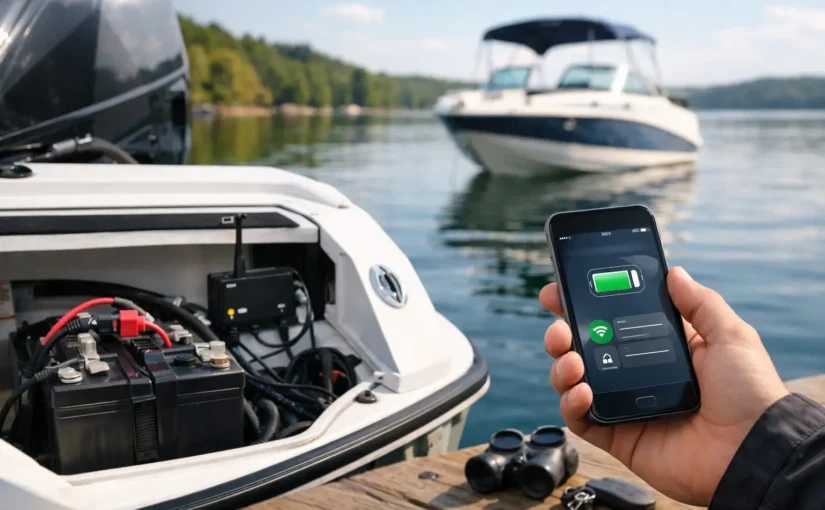
A boat battery rarely dies without warning. Shore power trips. A charger fails. A bilge pump starts cycling more than it should. A fridge, stereo memory circuit, or networked device keeps drawing current while the boat sits. The expensive part is not just replacing a battery. It is arriving at the dock to find dead electronics, an engine that will not crank, spoiled provisions, or a bigger systems problem that drained the bank in the first place. That is why more owners now look for ways to prevent dead boat batteries remotely instead of discovering the issue days or weeks later.
Why boat batteries die when nobody is aboard
Most dead battery events come from a short list of causes, but the details matter. The first is loss of shore power. If the pedestal breaker trips, the cord loosens, or marina power drops out, your charger stops replenishing the bank. If the boat still has background loads, voltage starts falling immediately.
The second is charger or charging-system failure. Shore power can still be present while the charger itself has stopped working or is underperforming. That is why simply knowing the boat still has dock power is helpful, but not enough on its own.
The third is parasitic draw. Many boats have small but persistent loads that owners underestimate. Battery monitors, stereo memory, alarm systems, lighting circuits, internet gear, and corrosion control equipment can all add up. Over a few days, a healthy bank may tolerate that draw. Over a few weeks, especially with older batteries, it becomes a problem.
Then there is the high-load scenario. A stuck bilge pump switch, water intrusion, a refrigeration issue, or an accessory left on can pull a bank down fast. In those cases, the battery is not the root problem. It is the first symptom you notice.
What it really takes to prevent dead boat batteries remotely
Remote battery protection is not one feature. It is a monitoring chain. You need visibility into battery voltage, charging status, and the conditions that affect both. If one of those pieces is missing, you are left guessing.
At minimum, remote oversight should tell you whether shore power is present, what your battery voltage is doing over time, and when values move outside safe thresholds. That gives you a chance to respond before a starting bank drops too low or a house bank becomes deeply discharged.
For many boats, that baseline should be expanded. If a bilge pump begins cycling repeatedly, battery drain may be the result of water intrusion, not an isolated electrical issue. If temperatures spike in storage, battery performance can suffer. If a vessel is unattended for long periods, connectivity reliability matters as much as the sensor itself. A missed alert is not much protection.
Prevent dead boat batteries remotely with the right alerts
Alerts are where remote monitoring becomes practical. Data alone does not protect a boat. Fast notification does.
A useful system should send an immediate alert when shore power is lost, when battery voltage drops below a defined threshold, and when the charger is no longer maintaining the expected range. For some owners, push notifications are enough. For others, especially those managing larger vessels or multiple boats, layered notifications by app, text, email, and phone call add needed certainty.
Thresholds matter too. Set them too low, and you learn about the problem after the battery is already stressed. Set them too high, and you create alarm fatigue. A starting battery and a house bank do not always deserve the same settings, and AGM, flooded, and lithium systems each behave differently. Good remote monitoring should support that reality instead of forcing a one-size-fits-all rule.
Shore power monitoring is the first line of defense
If your boat lives at a marina, shore power loss is often the first event in the chain. Catching it early can save a charger cycle, a service call, and a weekend lost to troubleshooting.
But there is a trade-off here. Some owners assume a shore power alert solves the battery problem completely. It does not. If the charger has failed but shore power is still present, the batteries can still discharge. If the pedestal goes down briefly and comes back before anyone checks the boat, a historic event log becomes valuable because it shows that the interruption happened at all.
That is why better systems pair shore power status with battery health monitoring. One tells you whether incoming power exists. The other tells you whether the battery bank is actually being maintained.
Battery voltage trends tell a better story than a single reading
A single voltage number can be misleading. Batteries rest, recover, and respond to load differently depending on chemistry, age, temperature, and whether a charger is active. What matters more is trend.
If voltage has been slowly stepping down over several days, that points to chronic draw or weak charging. If it drops sharply overnight, something changed quickly – often a heavy load, charger issue, or shore power interruption. If voltage remains artificially high because a charger is active but then falls fast under even light load, battery health may be declining.
This is where app-based historical visibility becomes useful. You do not just want to know that voltage is low now. You want to know when the decline began and what else changed at the same time. That context is what turns an alert into a fast diagnosis.
The battery problem may actually be a bilge, charger, or access issue
Owners often treat battery failure as a standalone maintenance item. On unattended boats, it is frequently a systems issue.
A bilge pump running too often can drain batteries even while signaling a more serious water intrusion problem. A door or hatch left open can increase cabin loads. A charger may be working intermittently. An unauthorized boarding event may leave equipment powered on. These are not theoretical edge cases. They are common reasons a healthy battery bank is dead by the next visit.
That is why the strongest remote setups do more than monitor voltage. They watch the conditions that cause battery drain. In practice, that means combining battery monitoring with shore power status, bilge activity, high-water alerts, temperature tracking, and access awareness. One alert explains the symptom. The others help identify the cause.
Connectivity is not a small detail
To prevent dead boat batteries remotely, the monitoring system has to stay online when the boat is unattended, marina Wi-Fi is inconsistent, or the vessel is stored away from reliable local networks.
This is where many consumer-grade workarounds fall short. A basic tracker or smart plug may function fine in ideal conditions, then drop offline when you need it most. Marine monitoring needs dependable communications, equipment built for the environment, and installation practices that respect onboard electrical safety.
For serious protection, dual connectivity options and marine-grade hardware are worth paying attention to. Salt, vibration, heat, humidity, and unreliable dock infrastructure expose weak products quickly. If the system cannot survive the boat, it cannot protect the boat.
Installation and setup affect the outcome
Even the best remote monitoring hardware can underperform if it is installed poorly or configured without thought. Battery leads need proper connections. Sensor placement matters. Alert thresholds should reflect the actual battery bank and vessel use pattern.
A weekend cruiser plugged into shore power year-round has different risk points than a boat on a mooring or in seasonal storage. A yacht with NMEA2000 backbone access can support deeper systems visibility than a simpler runabout. More data can be useful, but only if it helps the owner respond faster and with more confidence.
This is one reason marine-specific systems stand apart from generic IoT devices. ABYC-aligned wiring practices, purpose-built sensors, and support teams that understand how boats are actually used reduce the chances of blind spots.
A better standard for remote battery protection
The practical goal is simple. You want early warning before a low-voltage event becomes a no-start event. You want proof of shore power status, battery condition, and the related onboard factors that can drain a bank. You want alerts delivered through channels you will actually see. And you want a monitoring platform designed for boats, not adapted from home security or hobby electronics.
That is the logic behind a connected marine monitoring system such as EverWatch. When shore power, battery health, bilge activity, temperature, and onboard conditions are visible in one place, owners can act before a dead battery strands the boat or masks a deeper fault.
If your boat spends any meaningful time unattended, battery protection should not depend on guesswork, dock gossip, or the next time someone happens to stop by. The better move is constant oversight – so the first sign of trouble reaches you while there is still time to fix it.


 2-Year Warranty
 30-Day Money-Back Guarantee
 U.S.-Based Support