
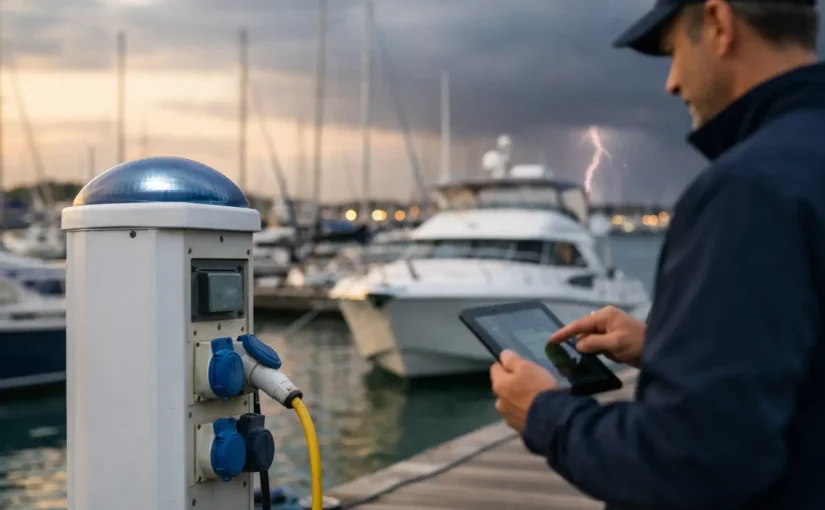
The call usually comes too late. Shore power drops sometime after midnight, the battery charger stops, refrigeration warms, dehumidifiers shut down, and by morning your boat is running on reserve power with nobody watching. If you want to detect marina power outages early, you need more than a pedestal check and a good feeling.
At a marina, shore power loss is rarely a single-event inconvenience. It can trigger a chain reaction across your vessel. Batteries begin discharging. Bilge pumps lose dependable charging support. Cabin humidity climbs. Freezers thaw. Security devices go dark. On boats with sensitive electronics, low-voltage conditions can create their own set of problems long before anyone at the dock notices an issue.
Why it matters to detect marina power outages early
The real risk is not the outage itself. The real risk is the delay between power loss and your response.
If your boat is unattended for days or weeks, even a short outage can become expensive. Battery banks may carry essential systems for a while, but that window depends on charger size, battery condition, onboard loads, and whether the outage affects one pedestal, one dock, or the entire marina. A healthy house bank on a lightly loaded vessel buys time. An older battery bank supporting refrigeration, internet gear, cameras, and pumps may not buy much.
That is why early detection matters. The sooner you know shore power is gone, the sooner you can confirm whether the issue is local to your slip, tied to a tripped breaker, caused by dock work, or part of a broader marina outage. That response window is where damage prevention happens.
What early detection actually looks like
Early detection is not someone noticing dark dock lights hours later. It is a monitoring system that recognizes the loss of shore power in near real time and sends alerts through channels you will actually see.
For most boat owners, that means an app notification backed by SMS, email, or phone call escalation. For larger vessels or multi-vessel operators, it also means visibility into related conditions. Has battery voltage started falling? Has cabin temperature risen? Has the bilge pump started cycling more often while charging support is offline? A shore power alert is useful. A shore power alert with context is far more actionable.
That is the difference between a simple alarm and a vessel monitoring system. An alarm tells you something happened. A monitoring platform shows what is changing because it happened.
The most common failure points at the marina
To detect marina power outages early and respond correctly, it helps to know where failures begin.
Sometimes the problem is upstream. The marina loses utility service, a dock panel breaker trips, or maintenance work interrupts power on a section of the property. In those cases, multiple boats may be affected at once.
Sometimes the problem is local to your boat. A shore cord may overheat, loosen, or corrode. An adapter can fail. An ELCI breaker may trip. A galvanic or wiring issue may create intermittent faults. If you only rely on a visual inspection during your last dock visit, you will not know the difference until the consequences show up.
There is also the gray area that catches many owners off guard – partial failure. You may still have some onboard systems active while battery charging has stopped. The boat appears fine from a distance, but the battery bank is quietly carrying loads it was never meant to support for long. This is where remote visibility matters most.
How to detect marina power outages early with the right setup
A practical setup starts with dedicated shore power monitoring on the vessel, not just dependence on marina staff or neighboring slip holders. The system should be marine-specific, designed for the electrical realities of dockside power, and installed with proper wiring practices.
From there, you want layered monitoring. Shore power status should be tied to battery voltage, charger behavior, and at least one environmental or safety condition such as bilge activity or high water. That combination tells you whether a power outage is just an inconvenience or the start of a more serious event.
Connectivity matters just as much as sensing. If the marina Wi-Fi drops during the same event, a Wi-Fi-only system may fail right when you need it. A better approach uses dual communication paths such as LTE and Wi-Fi so alerts still have a way out when one network is compromised.
Alerting should also be configured for urgency. Push notification alone is easy to miss. Shore power loss is the kind of event that often deserves escalation if it is not acknowledged quickly. Multi-channel alerts give you a better chance of seeing the problem while there is still time to act.
What to monitor alongside shore power
A shore power alert by itself is a strong first line of defense, but it should not operate in isolation.
Battery voltage is the obvious companion. Once shore power fails, the battery bank becomes the timeline. Watching voltage trends helps you estimate how long critical loads can continue before systems begin shutting down or performance degrades.
Bilge activity is another key signal. If pumps are cycling more often during a power loss event, your risk profile changes immediately. Water intrusion plus declining battery charge is not a wait-and-see scenario.
Temperature and humidity can also matter more than many owners expect. In hot climates or closed-up cabins, loss of AC power can accelerate mold growth, spoil provisions, and affect onboard finishes and electronics. On cold-weather boats, freeze risk may be the bigger concern. It depends on where the vessel is kept and what systems rely on shore power support.
For more technical owners, NMEA2000 data adds another layer. If charger-related electrical changes coincide with engine room temperature shifts, tank sensor anomalies, or other networked data, you get a fuller operating picture instead of a single disconnected alert.
False alarms, missed alerts, and the value of marine-grade design
Not every outage alert means a full-scale emergency. Brief pedestal interruptions happen. Marina work happens. Cellular conditions vary. The goal is not to eliminate every alert. The goal is to make alerts trustworthy enough that you act on them.
That comes down to system quality, installation quality, and alert logic. Consumer-grade smart plugs and generic IoT sensors often look inexpensive at the start, but they are usually not built for marine moisture, vibration, power irregularities, or the long unattended periods common in boating. They also tend to monitor one thing in isolation.
A marine-grade system should be designed for the environment and installed to standards that respect onboard electrical safety. ABYC-aligned wiring practices matter here. So does hardware built to stay online in conditions that cause household gadgets to fail.
This is where a dedicated platform such as EverWatch makes practical sense for owners who want more than a patchwork fix. The value is not just in detecting power loss. It is in maintaining constant vessel awareness through reliable hardware, dual LTE and Wi-Fi connectivity, and alerts that reach you before a preventable problem turns costly.
The response plan matters as much as the alert
If you detect marina power outages early but do not know what to do next, you have only solved half the problem.
A good response plan is simple. First, confirm whether the outage is isolated to your vessel or affecting a wider dock area. Second, check battery status and any related sensor conditions in the app. Third, contact marina staff or your local service contact if the situation requires an on-site check. If bilge activity, water intrusion, or rapid voltage drop is involved, escalate immediately.
The right plan depends on your boat. A center console on a lift has a different risk profile than a liveaboard cruiser with refrigeration, pumps, air conditioning, and multiple parasitic loads. A seasonal owner traveling out of state needs more automation and clearer escalation than someone who can be at the slip in twenty minutes.
That is why the best systems do not just send data. They support decision-making. They help you separate a temporary nuisance from an urgent electrical event.
A better standard for unattended boats
Boat ownership already comes with enough uncertainty. Shore power should not be one of the invisible risks you simply hope behaves while you are away.
When you detect marina power outages early, you protect more than chargers and batteries. You protect response time. And on an unattended vessel, response time is often the difference between a quick reset at the pedestal and a much bigger repair bill a few days later.
If your boat spends time at the dock without you onboard, remote power monitoring is no longer a nice extra. It is part of basic protection. Watch early, detect fast, and give yourself the chance to respond while the problem is still small.


 2-Year Warranty
 30-Day Money-Back Guarantee
 U.S.-Based Support