
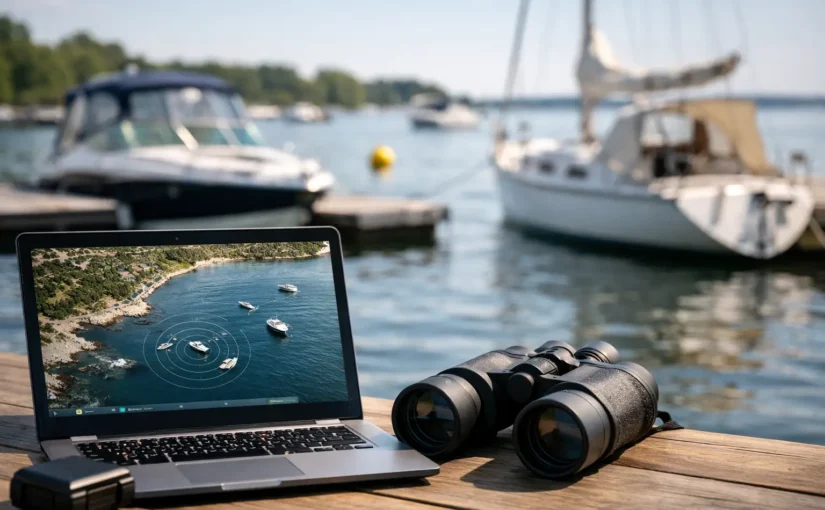
A boat does not need to be moving to be at risk. Most expensive problems happen when nobody is aboard – shore power fails, batteries drop, bilge pumps cycle too often, a hatch opens, or the vessel shifts where it should not. That is why boat owners asking how to track unattended boats are usually asking a bigger question: how do you keep watch when you cannot be there?
The short answer is that tracking an unattended boat is no longer just about putting a GPS dot on a map. Position matters, but position alone will not tell you that the charger is offline, the cabin is overheating, or water is entering the bilge. Real protection comes from combining location tracking with system monitoring and immediate alerts.
How to track unattended boats beyond simple GPS
A basic GPS tracker can tell you whether a boat has moved. That can help with theft recovery or unauthorized use, but it leaves major blind spots. If the boat is still tied to the dock while shore power drops and the batteries slowly die, a GPS tracker sees nothing wrong. If a bilge pump starts running repeatedly because water is coming in, a location-only device will stay silent.
For most docked, stored, or anchored vessels, proper unattended tracking means watching three things at once: location, vessel health, and environmental conditions. Location tells you where the boat is. Vessel health tells you whether key systems are stable. Environmental monitoring tells you whether heat, humidity, water intrusion, or an open hatch is creating a problem that will get worse by the hour.
That is the difference between tracking and monitoring. Tracking tells you where the boat went. Monitoring tells you what is happening on board right now.
The signals that actually matter when a boat is unattended
If your boat sits in a marina slip, on a lift, in dry storage, or on anchor for long periods, the right data depends on how the vessel is used. Still, a few signals consistently matter more than owners expect.
GPS position and geofencing are the obvious starting point. You want to know if the boat leaves its approved area, drifts off anchor, or moves unexpectedly. A geofence gives context to location data so you are not checking a map all day. Instead, you receive an alert when movement crosses a boundary you set.
Shore power status is just as important for many boats. A dock pedestal breaker can trip, a cord can loosen, or marina power can fail overnight. Once that happens, onboard chargers stop maintaining the batteries. Refrigeration, climate control, and other systems may also be affected. Catching that early can prevent a much bigger chain of failures.
Battery voltage is the next line of defense. It tells you whether the electrical system is staying healthy after shore power is lost, while the vessel is in storage, or during extended time on the hook. A slowly declining battery bank is easy to miss in person and expensive to ignore.
Bilge activity and high-water detection are critical because flooding events often start small. A failed hose clamp, leaking shaft seal, or rainwater issue may first show up as frequent pump cycles. If you only find out after the batteries are drained or the pump fails, the response window is gone.
Temperature and humidity alerts matter more than many owners realize. Excessive heat can damage interiors, electronics, and stored gear. Humidity drives mold and mildew, especially in enclosed cabins. For stored vessels in colder regions, freeze risk also belongs in the alert mix.
Doors, hatches, and access points add another layer. A vessel can remain in place but still be compromised by unauthorized entry or by a hatch left open before a storm.
For larger or more systems-driven boats, engine, transmission, and tank data from NMEA2000 networks can also be part of unattended oversight. That matters for owners who want one view of the full vessel, not a patchwork of disconnected devices.
Choosing the right setup for your boat
If you are deciding how to track unattended boats, match the system to the real risk profile of the vessel. A center console at a marina has different needs than a cruising yacht on a mooring or a sportfish in seasonal storage.
For a smaller boat used close to home, a standalone tracker may seem good enough. It is cheaper up front and can cover theft-related concerns. The trade-off is that you are only watching movement. You will not know about shore power loss, battery decline, bilge events, or temperature swings unless you add more devices.
That pieced-together approach often sounds practical until you live with it. One app tracks location. Another app handles a battery sensor. A separate alarm covers water intrusion. Some devices depend on Wi-Fi that drops out at the dock. Others are not designed for the marine environment and fail where corrosion, vibration, and moisture are constant.
For higher-value boats or owners who travel often, an integrated marine monitoring system is usually the better answer. It gives you one control point for GPS tracking, onboard sensors, connectivity, and alerts. It also reduces the chance that a blind spot develops between systems.
Marine-grade hardware matters here. So does installation quality. Boats are unforgiving electrical environments, and unattended monitoring has to stay online when conditions are rough and no one is nearby to reset it. Hardware designed for marine use, ABYC-aligned wiring practices, and dependable power management are not nice extras. They are what make the system worth trusting.
Connectivity is where many tracking plans fail
Tracking is only useful if the data gets off the boat reliably. That is where many low-cost setups come up short.
Some devices rely on a single connection path. If marina Wi-Fi drops or cellular coverage weakens, the system goes quiet. You may think the boat is fine when the truth is that you have simply lost visibility.
A better approach uses dedicated cellular connectivity and, when available, Wi-Fi as a secondary path. That dual-channel design helps maintain reporting and alert delivery in more real-world conditions. It also matters how alerts are sent. Push notifications are useful, but for urgent events like high water or unauthorized movement, SMS, email, and phone-call escalation create a stronger safety net.
This is where a purpose-built system earns its keep. EverWatch, for example, is designed around persistent remote oversight, with marine-grade hardware, dual LTE and Wi-Fi connectivity, expandable sensors, and multi-channel alerts built for unattended vessels rather than repurposed consumer electronics.
Installation and alert strategy matter as much as the hardware
Even the best equipment underperforms if alerts are poorly set up. Too few alerts and you miss developing problems. Too many and you start ignoring them.
Start with events that signal genuine risk: geofence breach, anchor drag, shore power loss, low battery voltage, high-water alarm, abnormal bilge pump activity, high temperature, and unauthorized entry. Then tune thresholds to your boat. A vessel that normally cycles its bilge pump after heavy rain needs a different baseline than one that should stay dry all week.
You should also think through who gets notified. If you are crossing time zones or unreachable for part of the day, your marina manager, captain, maintenance provider, or a family member may need to be included for certain alerts. Fast awareness is only half the job. The other half is having someone ready to act.
Installation should support that reliability. Sensor placement, clean wiring, protected power feeds, and proper integration with onboard networks all affect whether the system produces dependable information or nuisance alerts. On more complex vessels, professional installation is usually the smart move.
What boat owners often get wrong
The biggest mistake is assuming theft is the only threat worth tracking. In reality, many unattended losses come from maintenance issues and environmental events that build quietly. A boat can stay exactly where you left it and still suffer major damage.
The second mistake is buying for price alone. Cheap trackers can be fine for simple use cases, but they are often a poor fit for vessels that rely on shore power, have enclosed cabins, carry expensive electronics, or sit unattended for weeks at a time.
The third mistake is underestimating how much confidence comes from one clean view of the boat. When you can open an app and confirm location, power status, battery health, bilge behavior, and onboard conditions in seconds, you stop guessing. You start managing the boat proactively.
A better standard for unattended boat tracking
If you want to know how to track unattended boats effectively, think beyond location. The real goal is not just finding the boat after something goes wrong. The goal is catching trouble early enough to prevent the damage in the first place.
That means combining GPS tracking with sensor-based monitoring, reliable connectivity, strong alerting, and hardware built for marine service. When those pieces work together, you are not just watching a boat on a map. You are keeping constant watch over the systems that keep it safe.
The best setup is the one that tells you what changed, why it matters, and how quickly you need to respond. That is how unattended boats stay protected, even when you are miles away.


 2-Year Warranty
 30-Day Money-Back Guarantee
 U.S.-Based Support