
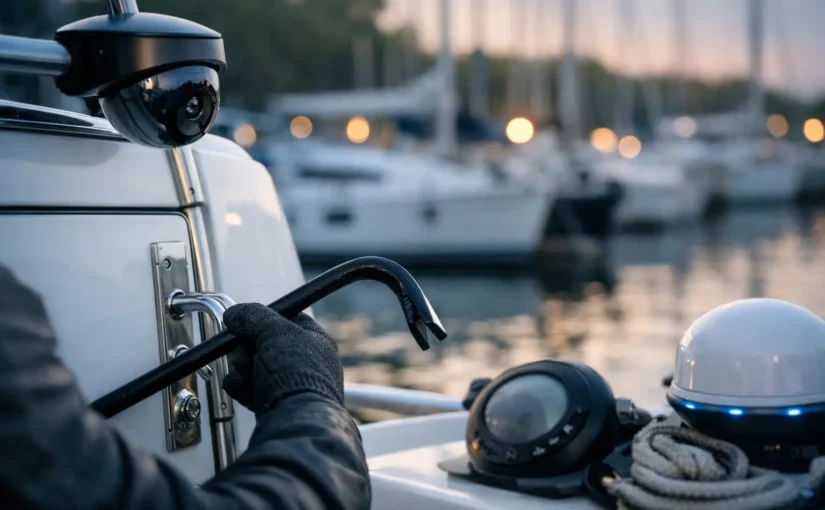
A stolen outboard, a missing chartplotter, a cut shore power cord, a boat moved one slip over – marina theft rarely starts with a dramatic break-in. More often, it starts with easy access, low visibility, and too much time before anyone notices. If you want to know how to stop marina theft, the answer is not one lock or one camera. It is layered protection built for the way boats are actually targeted.
Marinas create a difficult security environment. There is constant foot traffic, shared docks, rotating contractors, transient guests, and long stretches where owners are nowhere nearby. That makes boats attractive to thieves looking for electronics, tools, fuel, personal gear, and in some cases the vessel itself. Security has to do two jobs at once – slow down unauthorized access and shorten the time between an incident and your response.
How to stop marina theft starts with the real risk
Boat owners often focus on the most expensive theft scenario first, such as a stolen vessel or trailer. Those risks matter, but day-to-day marina theft is usually more opportunistic. Removable electronics, fishing gear, coolers, tenders, batteries, and even dock boxes are common targets. A thief does not need much time if the boat is easy to board and no one is watching.
That is why visible deterrence still matters. Locked hatches, secured consoles, tamper-resistant fasteners, and good dock lighting all raise the effort required. But physical security on its own has a limit. If a latch is forced at 1:40 a.m. and nobody sees it until Saturday, the damage is done. Effective protection depends on detection as much as deterrence.
Secure the points thieves actually use
Most marina theft happens through predictable entry points. Boarding gates, swim platforms, center console access, companionways, hatches, and canvas enclosures are all common weak spots. Owners sometimes overinvest in one high-end lock while leaving a simpler path untouched.
Start by looking at the boat the way a thief would. Can someone step aboard from the dock without attracting attention? Are expensive items visible through canvas or glass? Are locker lids easy to pry? Is the outboard secured with standard hardware that can be removed quickly? If the boat is on a trailer in storage, can it be hitched and moved in minutes?
The right countermeasures depend on the vessel. A center console may need stronger console and leaning post security. A cruiser may need better hatch and cabin door protection. A trailer boat may need wheel locks, coupler locks, and GPS-based movement awareness. The goal is not to make theft impossible. It is to make your boat a hard, noisy, time-consuming target.
Visibility changes behavior
A marina slip can feel private when you rent it, but from a security standpoint it is semi-public space. People who do not belong there can often blend in. That is why visible security measures have value beyond hardware strength.
Motion-activated lighting, marked equipment, alarm decals, and conspicuous monitoring devices tell a thief the boat is not passive. Even basic habits help. Do not leave portable electronics in plain sight. Do not leave high-value gear in the cockpit. Do not assume a canvas cover equals concealment if everyone on the dock knows what boat is unattended for weeks at a time.
There is a trade-off here. Highly visible deterrents can push thieves elsewhere, but they can also signal that valuable equipment is on board. The right balance is to show that the vessel is monitored without advertising every item worth stealing.
Remote monitoring is what closes the response gap
The biggest weakness in marina security is delay. Locks and cameras matter, but speed matters more once something starts to go wrong. If a hatch opens, shore power is cut, the battery is disconnected, or the boat moves outside its normal position, you need to know right away.
This is where connected vessel monitoring changes the equation. A marine-specific monitoring system can alert you when doors or hatches open unexpectedly, when battery voltage drops, when bilge activity spikes, or when GPS position changes beyond a geofence. Those signals are not all theft alarms by themselves. Together, they help you detect tampering, unauthorized boarding, and vessel movement before a small problem turns into a recovery claim.
For marina-kept boats, position monitoring is especially valuable. A thief moving a boat may not get far before an alert goes out. The same is true for trailers or tenders. If your security strategy depends on discovering a loss during the next marina visit, you are already behind.
Systems built for boats perform better here than patched-together consumer devices. Marine-grade hardware, stable onboard power integration, dual connectivity paths, and sensor expansion matter in wet, corrosive, vibration-heavy environments. Consumer trackers and standalone alarms often fail where boat owners need reliability most.
Build a layered plan instead of buying gadgets
Owners trying to figure out how to stop marina theft sometimes end up with disconnected tools – one camera, one tracker, one padlock, one battery alarm. The problem is not that any one of those tools is bad. The problem is that gaps between them create blind spots.
A better approach is to build layers. The first layer is deterrence: lighting, visible security, marked gear, and hardened entry points. The second is delay: stronger locks, secured engines and electronics, and reduced visibility of valuables. The third is detection: sensors for access points, movement, power interruption, and onboard conditions. The fourth is response: instant notifications, marina staff contacts, local law enforcement, and a clear plan for what happens when an alert hits your phone.
That last layer is where many owners fall short. An alert is only useful if it reaches the right person and triggers action. Push notifications are good. SMS, email, and phone call escalation are better. Multi-channel alerting matters when your phone is on silent, you are flying, or one communication path fails.
Work with the marina, not around it
Even the best onboard security system works better when the marina is part of the response loop. Ask direct questions. Are docks gated? Are contractors screened? Is there camera coverage on common access points? Who is on site after hours? How are suspicious persons handled? Can staff verify a boat after an alert?
Some marinas are excellent partners. Others offer little more than perimeter lighting and general patrols. You need to know which environment you are in. If your marina has weak controls, your onboard monitoring and hardware security need to carry more of the load.
It also helps to make your boat easier to identify and harder to resell in pieces. Record serial numbers. Photograph electronics and engines. Mark removable gear. Keep documentation current. Recovery odds improve when details are ready immediately instead of assembled after the fact.
The theft risks that get missed
Not every marina theft looks like missing hardware. Fuel theft, battery theft, shore power tampering, and unauthorized use are common and sometimes harder to spot. A boat can also be entered without anything obvious taken, only to be used for shelter, vandalized, or set up for a return visit.
That is why condition alerts belong in the security conversation. If shore power drops unexpectedly after a theft attempt, you need to know. If batteries are drained because systems were left on during unauthorized entry, you need to know. If the bilge starts cycling after tampering or water intrusion, you need to know before the problem compounds.
Security on a boat is never just about stolen property. It is about preventing the expensive chain reaction that follows unattended interference.
How to stop marina theft with a practical routine
Good security is not one installation day and then forget it. It is a repeatable routine. Before leaving the boat, secure visible gear, lock access points, confirm monitoring is armed, and check that alert contacts are current. Review geofence settings and make sure the system is actually reporting. If you leave the boat for weeks or months, remote status checks should become part of ownership, not an afterthought.
For higher-value vessels or owners who travel often, a more complete monitoring stack is worth it. Hatch and door sensors, battery and shore power monitoring, high-water alerts, temperature and humidity visibility, and GPS position awareness give you a much clearer picture of whether a theft event is beginning or whether another onboard issue is unfolding. EverWatch Systems is built around that exact need – watch, detect, and respond when you are not at the dock.
The hard truth is that no marina is theft-proof. But boats are not stolen because owners care too much about security. They are stolen because access was easy, detection was weak, and response took too long. Tighten those three points, and you shift the odds back in your favor.
Protect the boat like you will not get a second chance to catch the first sign of trouble, because in most theft cases, that first alert is the moment that matters.


 2-Year Warranty
 30-Day Money-Back Guarantee
 U.S.-Based Support