
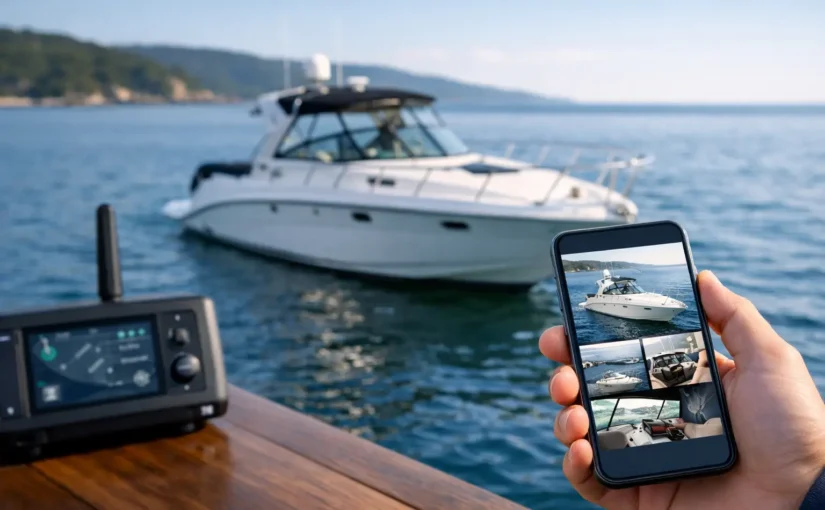
You leave the marina on Sunday afternoon. By Tuesday night, shore power trips, the batteries start dropping, and the fridge, charger, and other onboard systems begin to go quiet. If no one sees it for two days, a small electrical issue can turn into spoiled provisions, drained batteries, or worse. That is the real question behind is remote boat monitoring worth it – not whether the tech is interesting, but whether earlier awareness changes the outcome.
For many boat owners, it does. But not for every boat, and not for every setup. The value depends on what can go wrong while you are away, how long your boat sits unattended, and how expensive a delayed response could become.
Is remote boat monitoring worth it for most owners?
If your boat lives in a slip, on a mooring, at anchor, in dry storage, or anywhere out of sight for days or weeks at a time, remote monitoring usually earns its keep. Boats fail quietly. Bilge pumps cycle too often. Batteries drain slowly. Water finds a path through a hatch seal. Shore power disconnects in the middle of the night. None of these events need much time to become costly.
The strongest argument for monitoring is simple: time matters. A high-water alert at 2:00 a.m. gives you a chance to call the marina, a captain, or a nearby contact before the problem compounds. A low-battery alert can help you prevent dead electronics, refrigeration loss, and repeated deep discharge that shortens battery life. A GPS or geofence alert can catch unauthorized movement before a missing boat becomes a recovery case.
If you use your boat every few days and keep it where you can physically check it often, the equation changes. You may still want the oversight, but the savings become less dramatic. Remote monitoring delivers the most value when distance, downtime, and risk exposure are all high.
What you are really paying for
Some owners look at a monitoring system and see another hardware purchase plus another annual subscription. That is fair. But the comparison should not be between monitoring and spending nothing. It should be between monitoring and the cost of late discovery.
A single preventable incident can outweigh years of service. Replacing batteries damaged by repeated discharge is expensive. Water intrusion can mean upholstery damage, electrical corrosion, mold, and cleanup costs that keep climbing after the first repair. Shore power loss can disable chargers, refrigeration, and climate control. If humidity and temperature go unmanaged in storage, cabin materials suffer quietly.
There is also the less visible cost: wasted time and uncertainty. Many owners already check on their boats by calling the marina, asking neighbors, hiring local help, or driving out just to confirm everything is normal. A good remote system reduces those unnecessary checks and reserves your attention for real issues.
That said, not every system offers the same value. A low-cost tracker that only shows location is not the same as a marine monitoring platform that watches shore power, battery health, bilge activity, intrusion points, temperature, humidity, and onboard data. If the system only tells you where the boat is, it may help with theft recovery, but it will not help much with the failures that happen most often.
Where remote monitoring pays off fastest
The owners who see the clearest return are usually dealing with one or more of the same conditions. Their boat is unattended for long stretches. The vessel has systems that need to stay live while docked or stored. The owner travels often or lives far from the marina. Or the boat itself has enough value that even a minor incident becomes expensive.
A 22-foot center console on a trailer near home has a different risk profile than a 45-foot cruiser in a wet slip with shore power, refrigeration, pumps, HVAC, and multiple battery banks. The larger and more system-dependent the vessel, the stronger the case for continuous oversight.
Seasonal owners are another strong fit. If your boat sits for weeks between visits, you need a way to know what happened yesterday, not what happened sometime last month. The same applies to multi-vessel owners and operators. Once you are responsible for more than one boat, manual checking stops being efficient.
Is remote boat monitoring worth it if you already have marina staff?
Sometimes yes, and sometimes absolutely yes.
Marina staff can be valuable eyes on the dock, but they are not a dedicated monitoring system for your boat. They are managing an entire property, often around weather events, service demands, arrivals, departures, and other emergencies. They may notice an obvious issue. They may not catch the first signs of battery decline, intermittent shore power loss, rising humidity, repeated bilge cycling, or a hatch opened after hours.
Remote monitoring works best as an early-warning layer, not a replacement for human support. It gives you direct visibility and alerts the moment conditions change. Then you decide how to respond. You can call the marina with specifics instead of asking for a general look-around. That changes the quality of the response.
The trade-offs owners should consider
Remote monitoring is not magic. It does not fix a failed pump, resecure a loose shore cord, or stop a leak by itself. It shortens the time between problem and response. That distinction matters.
You also need the right system architecture. Marine use is unforgiving. Consumer smart-home devices often struggle with vibration, moisture, power instability, and weak connectivity on the water. A boat system should be marine-grade, safely installed, and designed around real vessel risks. ABYC-aligned wiring practices matter. Reliable connectivity matters. If a device cannot stay online or send alerts through multiple channels, the value drops fast.
Subscription cost is another fair concern. Monitoring depends on connectivity and alert delivery, so recurring service is part of the model. For some owners, that ongoing cost is easy to justify. For others with lower-risk boats, it may feel excessive. The honest answer is that the subscription makes sense when the boat has meaningful unattended risk. If your exposure is minimal, the benefit may be more convenience than protection.
What to look for before deciding
If you are trying to judge whether remote boat monitoring is worth it for your situation, focus on practical coverage, not marketing claims.
First, ask what the system can actually detect. Shore power, battery voltage, bilge activity, high water, temperature, humidity, door or hatch status, GPS position, and geofencing cover many of the most common unattended risks. For more advanced owners, NMEA2000 access adds real operational value by bringing engine, transmission, and tank data into view.
Second, look at how alerts are delivered. Push notifications are useful, but critical events should not depend on a single alert method. SMS, email, and phone call escalation create more confidence when the issue is urgent.
Third, ask how the system stays connected. Boats do not live in perfect signal conditions. Dual LTE and Wi-Fi capability gives better odds that data and alerts keep moving when one path is unavailable.
Fourth, consider expandability. Boats vary widely. A system that lets you add sensors for intrusion, water, environmental conditions, or additional systems will age better with the vessel and your needs.
This is where a purpose-built platform stands apart from pieced-together gadgets. EverWatch Systems, for example, is built around marine-grade hardware, ABYC-aligned installation standards, app-based visibility, and layered alerting for exactly these unattended scenarios. That kind of design is what makes monitoring useful in the real world, not just appealing on a spec sheet.
When the answer is probably no
There are cases where remote monitoring may not be worth the expense. If your boat is stored at home, used frequently, disconnected from shore power, lightly equipped, and easy to inspect at any time, your risk may be low enough that manual checking works fine. The same may be true for a simple trailer boat that rarely sits unattended for long.
It can also be a poor fit if you are only buying for curiosity. If you do not care about alerts, do not plan to respond quickly, and mainly want occasional data for interest, you may not use the system enough to justify the cost.
The key question is not whether monitoring is good technology. It is whether faster awareness gives you a meaningful chance to prevent damage, loss, downtime, or stress.
For many owners, the answer is yes because boats rarely fail when you are standing next to them. They fail after you lock the hatch, leave the dock, and assume everything will be fine until next weekend. If your boat spends real time unattended, paying for visibility is often cheaper than paying for surprise.


 2-Year Warranty
 30-Day Money-Back Guarantee
 U.S.-Based Support