
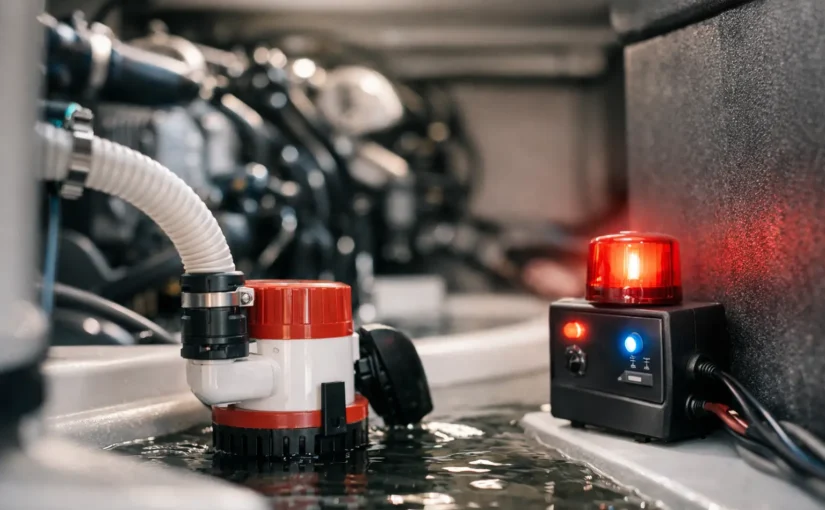
A bilge pump cycling at 2:13 a.m. is not background noise. It is your boat telling you something has changed – rainwater is building up, a hose has failed, a shaft seal is leaking, or water is getting in somewhere it should not. A bilge pump alert system exists for that exact moment. It gives you immediate visibility into bilge activity so you can respond before a nuisance becomes a repair bill, an insurance claim, or a sinking.
For many owners, the real risk is not a single pump cycle. It is the boat sitting unattended while the pump keeps running, the batteries keep draining, and nobody knows there is a problem until the dock staff spots the waterline sitting too low. Early detection changes that timeline. Instead of discovering damage after the fact, you get a warning while there is still time to act.
Why bilge alerts matter more than a float switch alone
A float switch turns a pump on when water reaches a certain level. That is necessary, but it is not the same as monitoring. The switch may activate and the pump may run, yet you still have no idea how often it happened, how long it ran, or whether the pump is keeping up.
That gap matters. A short pump cycle after heavy rain may be normal. Repeated cycles every few minutes are not. A pump that runs longer than usual may signal a worsening leak, a clogged discharge line, a weak battery, or a failing pump. Without alerts, those patterns stay hidden until the consequences are obvious.
A proper bilge pump alert system does more than sound a local alarm at the boat. It records activity, sends notifications off-vessel, and gives you enough context to decide whether this is a watch-and-wait situation or a call-the-marina-right-now problem.
What a bilge pump alert system should monitor
Not every system is built to the same standard. Some products only tell you that a high-water float has tripped. Others give you a fuller picture of what is happening in the bilge and what may happen next.
At minimum, the system should detect bilge pump activity and notify you remotely. That means push alerts to your phone, not just a buzzer onboard that nobody hears after the gate closes. For many owners, SMS, email, and phone-call escalation are just as important, especially if the boat is stored somewhere with limited access or you are traveling.
It should also track repeated pump events over time. One alert is useful. A history of cycles is better. Trend visibility helps you separate a one-off event from a developing failure.
The strongest setups monitor the supporting systems that determine whether the pump can keep protecting the boat. Battery voltage matters because a pump cannot run on a dead bank. Shore power matters because battery charging may be the difference between a controlled event and a flooded cabin. Water intrusion and high-water detection add another layer because a standard pump-cycle alert may not tell you whether water is rising faster than the pump can remove it.
This is where integrated boat monitoring becomes more valuable than a stand-alone alarm. A bilge event rarely happens in isolation. It often shows up with power loss, low battery, humidity changes, or other signs that the situation is escalating.
The difference between local alarm products and connected monitoring
A simple bilge alarm has a place. It is better than no warning at all, and for some small boats it may cover a basic need. But local alarms have an obvious weakness. If nobody is aboard, nobody hears them.
Connected monitoring solves the unattended-boat problem. Instead of relying on someone being within earshot, the system pushes alerts to you wherever you are. That is the difference between finding out at the dock and finding out at dinner, at work, or halfway through a flight connection.
The trade-off is cost and complexity. A connected system involves hardware, installation, and usually a recurring service plan for cellular connectivity and cloud-based alerting. For owners of higher-value boats, cruisers, sportfishers, yachts, and vessels left alone for long stretches, that trade-off usually makes sense. The cost of one preventable high-water incident can dwarf the cost of monitoring.
Installation details that matter on a real boat
Marine monitoring only works if the hardware is built and installed for the environment it lives in. Salt air, vibration, moisture, voltage swings, and long unattended periods expose weak design quickly.
That is why wiring standards, enclosure quality, and sensor reliability matter. Marine-grade hardware and ABYC-aligned installation practices are not marketing extras. They are part of making sure the alert system stays online when conditions get ugly.
Placement also matters. If you are monitoring pump activity, the system needs to be tied into the right circuits and configured to reflect actual bilge behavior. If you are adding high-water detection, sensor location needs to account for the boat’s bilge layout, not just an idealized diagram. A poor sensor location can create nuisance alerts or, worse, delayed warnings.
Connectivity is another practical issue. Boats move between marina Wi-Fi, cellular coverage, dry storage, and remote anchorages. A system that supports more than one communication path gives you better odds of staying connected when one network drops out. That redundancy is not theoretical. It is part of dependable remote oversight.
What good alerts look like in practice
A useful alert tells you what happened and gives you enough confidence to act. “Bilge active” is a start. Better alerts add timing, repeat events, and supporting system data.
For example, if your phone shows repeated bilge pump activations over the last hour along with falling battery voltage, that is a very different situation from one brief cycle during a rainstorm while shore power is stable. Context reduces guesswork.
The same principle applies to escalation. Some events warrant a push notification only. Others justify SMS, email, or a phone call because delayed response increases the chance of damage. Multi-channel alerting is not overkill when the boat is unattended and minutes matter.
For owners managing more than one vessel, centralized app visibility matters just as much. You do not want separate gadgets with separate logins and partial information. You want one system view that shows which boat needs attention now.
A bilge pump alert system is strongest when it is part of a wider watch
Bilge monitoring is critical, but on its own it only tells part of the story. The better approach is to treat it as one layer in a full protection stack.
If shore power fails, battery charging may stop. If batteries drop, the pump’s operating margin shrinks. If a hatch leaks during a storm, humidity and water intrusion can rise before serious flooding is visible. If the boat breaks free or moves unexpectedly, GPS and geofencing matter just as much as bilge status.
That is why many serious owners move away from pieced-together consumer alarms and toward purpose-built marine systems. A connected platform can tie bilge activity to battery health, shore power status, water intrusion, temperature, location, and even NMEA2000 vessel data. That gives you one operating picture instead of scattered warnings.
EverWatch is built around that kind of layered protection – marine-grade hardware, remote connectivity, and alerting that watches the boat when you cannot.
Who needs this most
Some boats can get by with simple onboard alarms. Others should not rely on them.
If your vessel stays in a slip full-time, sits on a mooring, remains unattended between weekend trips, or lives in seasonal storage, remote bilge visibility is a smart investment. The same is true if you travel often, manage multiple boats, or keep a higher-value vessel where delayed response carries a serious cost.
Even technically capable owners benefit here. Knowing how your bilge system works does not help if the problem starts while you are 200 miles away. The issue is not just awareness of boat systems. It is awareness at the moment something changes.
How to evaluate your options
When comparing systems, focus less on promises and more on operating reality. Ask whether the system sends remote alerts without requiring someone to be nearby. Ask how it communicates, what happens if one network path fails, and whether it logs bilge events over time.
Look at expansion too. You may start with bilge monitoring and then decide you also want shore power, battery, high-water, intrusion, GPS, hatch, or NMEA2000 data. A platform that grows with the boat is usually a better long-term decision than a one-purpose alarm that forces you to start over later.
Finally, consider support. Boats are not generic IoT environments. Marine electrical systems, corrosion exposure, and installation constraints are different. U.S.-based support and marine-specific design experience carry real value when you are protecting a serious asset.
A good bilge pump alert system does one job above all else – it shortens the distance between a hidden problem and your response. That window is where damage is prevented, batteries are saved, pumps are replaced before they fail, and bad days stay small. If your boat spends any meaningful time unattended, that kind of watch is not a luxury. It is control when control matters most.


 2-Year Warranty
 30-Day Money-Back Guarantee
 U.S.-Based Support