
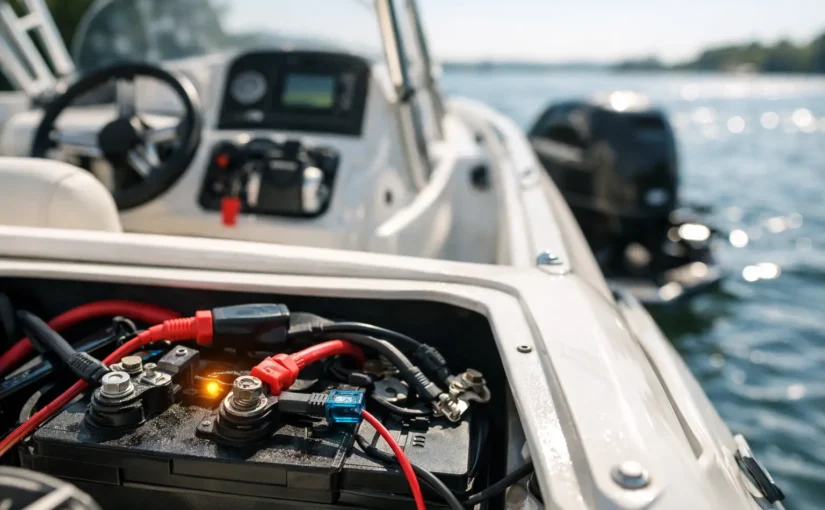
A boat that starts fine on Saturday and sits dead by the following weekend usually is not suffering from one dramatic failure. More often, what causes boat battery drain is a steady, overlooked load somewhere in the system, combined with charging issues, aging batteries, or time away from the dock. The problem gets expensive when it stays hidden. A drained battery bank can mean no engine start, no bilge protection, spoiled weekends, and in worst cases, real vessel risk.
What causes boat battery drain when the boat is idle?
Most owners assume battery drain only happens when they are actively using the boat. In reality, many boats lose power faster while sitting unattended. Small electrical draws continue around the clock, and over several days or weeks, those draws add up.
Common idle loads include bilge pumps cycling more often than expected, stereo memory, chartplotters in standby, alarm systems, trackers, CO detectors, refrigerators, battery chargers with faults, and inverters left on. None of these need to be huge loads to create a problem. A modest parasitic draw that seems harmless overnight can flatten a battery bank over a long storage period.
That is why battery drain is not just an electrical annoyance. It is a monitoring problem. If you do not know what is active, when voltage starts dropping, or whether shore power has failed, you are troubleshooting after the damage is already underway.
The most common sources of battery drain
Parasitic loads that never fully turn off
This is one of the most frequent causes. Boats often have electronics that appear off but still draw current. Memory circuits, digital switching modules, amplifier standby modes, GPS devices, security accessories, and network gateways can quietly consume power 24 hours a day.
The trade-off is convenience. Many owners want systems ready instantly, with settings saved and remote functions available. That convenience costs battery capacity. On a boat used frequently, the drain may go unnoticed. On a boat sitting for two or three weeks, it becomes obvious.
Bilge pumps cycling too often
A bilge pump is supposed to protect the boat, but if it is running more than normal, it can deplete batteries fast. This may happen because of a leaking shaft seal, rainwater intrusion, a stuck float switch, plumbing leaks, or water entering through fittings or hatches.
This is where battery drain can signal a larger problem. If battery voltage keeps dropping because the bilge pump is working overtime, the real issue may be water where it should not be. Owners who only replace the battery may miss the actual threat.
Battery charger or shore power failure
Many boats rely on shore power and a charger to keep batteries topped off while docked. If shore power drops, a breaker trips, the charger fails, or a cord connection overheats and disconnects, the boat instantly shifts from maintained power to battery-only operation.
Once that happens, every onboard load begins pulling from the bank with no replenishment. Refrigeration, pumps, monitoring equipment, and background electronics continue to run until voltage falls too low. On an unattended vessel, that can happen long before the owner returns.
Old or damaged batteries
Sometimes what causes boat battery drain is not an excessive load at all. It is a battery that can no longer hold a charge. Marine batteries lose capacity with age, heat, vibration, sulfation, and repeated deep discharge. A battery may still show acceptable voltage right after charging but collapse quickly under normal load.
This is why battery age matters. A five-year-old battery bank in a hot climate behaves differently than a newer bank maintained correctly. Even high-quality batteries are consumable components. If they have been neglected, undercharged, or discharged too deeply too many times, replacement may be the only real fix.
Incorrect battery switch settings
A simple selector switch error can create a drain issue that looks more mysterious than it is. Leaving the house bank connected to more loads than intended, combining banks unnecessarily, or setting the switch incorrectly during storage can drain start batteries along with accessory batteries.
The details depend on the boat’s wiring design. Some setups isolate loads well. Others allow crossover between banks in ways owners do not realize until both banks are weak.
Inverters, refrigerators, and high-draw accessories
Some drains are not hidden at all. They are just underestimated. Inverters, onboard entertainment systems, refrigerators, freezers, livewell pumps, bait systems, and cabin accessories can consume significant power, especially if the charging system is not keeping pace.
The issue here is usage pattern. A battery bank sized for short day trips may not support overnight anchoring, extended weekends, or hot-weather refrigeration loads. Owners often discover this after adding new accessories without reassessing total demand.
Charging problems that look like battery drain
Not every dead battery is the result of current leaving the bank too quickly. Sometimes the bank was never properly recharged in the first place.
Alternators can underperform. Chargers can be undersized or set to the wrong battery chemistry. Corroded terminals and poor connections can reduce charging efficiency. Solar systems may contribute less than expected because of shading, controller issues, or poor panel placement. If batteries are only partially recharged between trips, their state of charge declines over time until the boat appears to have a drain problem.
This is one reason marine electrical issues can be deceptive. Two boats can show the same low-voltage symptom while suffering from completely different causes. One has a parasitic load. The other has weak charging recovery. The fix is different in each case.
Wiring faults and corrosion
Marine environments are hard on electrical systems. Moisture, salt, vibration, and heat attack connections over time. Corroded terminals create resistance. Loose grounds cause unstable behavior. Damaged insulation can lead to unintended current paths or intermittent loads that are hard to replicate during a quick inspection.
ABYC-aligned wiring practices matter here because good overcurrent protection, proper wire sizing, correct termination methods, and clean battery connections reduce both performance loss and safety risk. A boat with aging, improvised wiring is far more likely to develop unexplained drain than one with marine-grade electrical standards throughout.
How to tell what is causing the drain
The first step is to stop guessing. Measure resting voltage, then check current draw with systems off and with known loads active. Isolate battery banks if possible. Turn off breakers one at a time and watch for a meaningful drop in draw. If the draw disappears when one circuit is opened, you have narrowed the search.
Then look at the bigger pattern. Does the drain only happen at the dock? Only after rain? Only when shore power is interrupted? Only after a few weeks away? These details matter. A pump-related drain behaves differently than an old battery bank or a charger failure.
Remote visibility changes the speed of diagnosis. If you can see battery voltage trends, shore power status, bilge activity, and environmental conditions while away from the boat, you do not have to reconstruct the event after the fact. You can see when voltage began to fall and what else was happening at the same time.
Preventing battery drain before it becomes a bigger problem
Prevention starts with load awareness. Know what stays on when the boat is unattended. Confirm battery charger settings match your battery type. Test shore power alerts. Inspect bilge pump behavior. Replace batteries on condition, not optimism.
It also helps to think in layers. Good batteries alone are not enough. Good chargers alone are not enough. You need dependable charging, clean wiring, controlled parasitic loads, and immediate awareness when something changes. That is where a connected monitoring system earns its place. A platform like EverWatch can alert you to falling battery voltage, shore power loss, abnormal bilge pump activity, and other conditions that often sit behind a dead battery event.
For owners who leave boats at marinas, in storage, or on moorings, that early warning is the difference between a routine correction and a much more expensive service call.
Why this problem deserves attention
Battery drain is easy to dismiss because the first symptom is often small. The engine cranks slower. A chartplotter reboots. Cabin lights dim. But batteries support more than convenience on a modern boat. They support pumps, alarms, monitoring, communications, and starting power when you need it most.
If your boat keeps showing weak batteries, treat it as a system warning, not a one-time inconvenience. Find the load. Verify the charging source. Check the bank’s real condition. Watch what happens when you are away, not just when you are onboard. The boats that stay ready are usually the ones being watched closely, even when nobody is aboard.


 2-Year Warranty
 30-Day Money-Back Guarantee
 U.S.-Based Support