
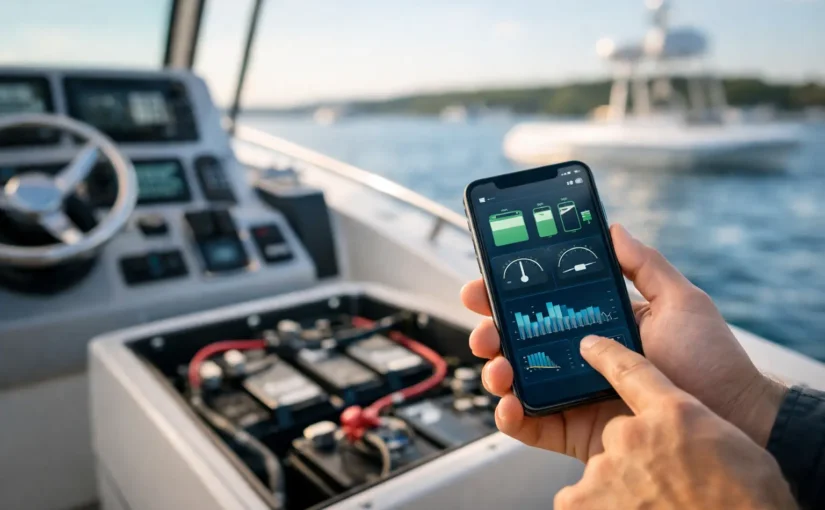
A dead house bank rarely starts as a surprise. It usually starts with a small voltage drop at the dock, a charger that stops getting shore power, or a parasitic load that keeps pulling current while nobody is aboard. A boat battery monitoring app is supposed to catch that early. The question is whether it only shows you a number on a screen, or actually helps you protect the boat.
That distinction matters. On a modern vessel, battery health is tied to much more than engine starting. Batteries support bilge pumps, alarms, lighting, communications, refrigeration, inverters, and control systems. If battery capacity falls too far, what looks like a simple electrical issue can turn into flooding risk, spoiled systems, failed starts, or expensive service calls.
What a boat battery monitoring app needs to monitor
At minimum, the app should show battery voltage in real time and over time. A static voltage reading has limited value by itself. What matters is trend. If you can see the bank resting lower each day, or dropping fast after shore power fails, you have useful information before the boat reaches a critical condition.
A better boat battery monitoring app also pairs voltage with charging status and alert logic. If the batteries are low, you need context. Did the charger lose AC input? Did a breaker trip? Did the dock pedestal fail? Without that connection, the app tells you a symptom but not the likely cause.
For many owners, one bank is not enough. A center console, cruiser, sailboat, or yacht may have separate start and house banks, plus thruster, generator, or electronics batteries. If the app only watches a single circuit, it leaves blind spots. Multi-bank visibility is not a luxury on a vessel with layered electrical demands. It is basic protection.
Voltage alone is not enough
Plenty of battery apps stop at voltage display. That can work for a trailer boat stored close to home, where the owner checks often and can respond quickly. It is not enough for a vessel kept in a marina, on a mooring, in dry storage, or unattended for weeks at a time.
Voltage tells you the present state. It does not tell you what happens next if no one intervenes. A meaningful monitoring setup should notify you when voltage crosses thresholds you define, and it should do it immediately. Push notifications help, but they should not be the only path. When battery problems develop overnight or during bad weather, missed notifications can be costly. SMS, email, and phone-call escalation provide a stronger safety net.
There is also a difference between nuisance alerts and useful alerts. If the app pings constantly for every small fluctuation, owners start ignoring it. If thresholds are too broad, it warns too late. The best systems let you tune the alert logic to the vessel, battery type, charging profile, and how the boat is used.
Why charging context changes everything
A battery bank at 12.2 volts means one thing at anchor and something very different at the slip with shore power connected. That is why charging context matters. A stronger system watches shore power status alongside battery voltage so you know whether the bank is discharging under normal off-grid use or drifting down because charging stopped unexpectedly.
That distinction shortens troubleshooting. If shore power drops and battery voltage begins falling, the issue may be pedestal power, a disconnected cord, a tripped breaker, or charger failure. If shore power is present and the bank still falls, the problem shifts toward charger output, battery condition, or onboard load. The app should help you make that call fast.
The best app is part of a full monitoring system
Battery trouble rarely happens in isolation. When a boat loses shore power, battery discharge becomes part of a chain of risk. Bilge pumps may be forced to run on battery alone. Cabin temperatures may climb. Refrigeration may stop. Security devices may lose support. If the vessel takes on water during that same event, the consequences stack quickly.
That is why the most capable solution is not just a battery app. It is a connected boat monitoring system that ties battery health to the rest of the vessel. When voltage, shore power, bilge activity, water intrusion, temperature, location, and engine or tank data are visible in one place, owners can see the whole situation instead of guessing from one metric.
For boaters who leave vessels unattended, this matters more than feature count on a product sheet. It is the difference between reading data and getting protection.
Boat battery monitoring app features that actually matter
Remote access is the first non-negotiable. If the app only works over Bluetooth at the dock, it is a convenience tool, not a protection tool. Real monitoring means cellular or Wi-Fi connectivity that keeps reporting when you are away from the boat.
Marine-grade hardware matters just as much as app design. Consumer sensors and generic IoT devices often look attractive until they face vibration, moisture, corrosion, and the wiring realities of an engine room or lazarette. A battery monitoring platform installed on a boat should be built for marine conditions and wired in a way that respects ABYC-aligned practices.
Expandability is another dividing line. Some owners want simple battery and shore power oversight. Others want to add bilge counters, high-water alarms, hatch security, GPS tracking, anchor watch, temperature sensors, humidity alerts, and NMEA2000 data for engines and tanks. A system that can grow with the boat protects your investment and avoids another round of disconnected devices later.
App usability still matters
A marine monitoring platform can have excellent hardware and still fail the owner if the app is confusing. You should be able to open the app and understand the boat’s condition in seconds. Battery status, active alerts, connectivity state, and other critical values should be obvious.
History matters too. If your app shows only a current reading, you lose the ability to spot patterns. Trend views help identify recurring shore power drops, weak battery recovery, increased overnight loads, or seasonal issues during storage. The point is not more charts for the sake of charts. The point is faster decisions.
Who needs more than a simple battery app
Not every owner needs the same level of monitoring. If your boat sits in your driveway and you use it every weekend, a basic battery tracker may be enough. You are nearby, response is easy, and risk exposure is lower.
But if your boat stays in a slip, a rack facility, a yard, or on anchor while you are away, the calculation changes. Seasonal owners, frequent travelers, multi-vessel operators, and yacht owners have a longer response window and higher downside. They need active oversight, not occasional checking.
That is where a system like EverWatch makes more sense than a single-purpose app. Instead of watching battery voltage in isolation, it watches the conditions that cause battery events and the systems battery loss can affect. That includes shore power, bilge activity, water intrusion, GPS position, geo-fencing, temperature, humidity, and NMEA2000 vessel data, with alerts delivered through multiple channels.
How to evaluate your options without getting distracted
Start with one question: what happens if the battery starts falling at 2:00 a.m. and no one is aboard? If the answer is that you will see it next time you open the app, keep looking. If the answer is that you will be alerted immediately and can also see shore power status, bilge activity, and the rest of the boat’s condition, you are evaluating a real monitoring solution.
Then look at connectivity. Bluetooth-only systems are fine for local checks. They are not designed for remote protection. For unattended vessels, persistent connectivity is the standard.
Next, look at alerting. One notification method is better than none, but redundancy matters when the stakes are high. Finally, look at installation quality and marine fit. Boats are not houses, and they are not cars. Marine electrical systems deserve equipment and wiring practices designed for marine service.
A boat battery monitoring app should reduce uncertainty, not just display data. The right one warns early, shows context, and fits into a system built to watch the entire vessel while you are away. That is how you turn battery monitoring from a nice feature into a practical layer of protection.


 2-Year Warranty
 30-Day Money-Back Guarantee
 U.S.-Based Support