
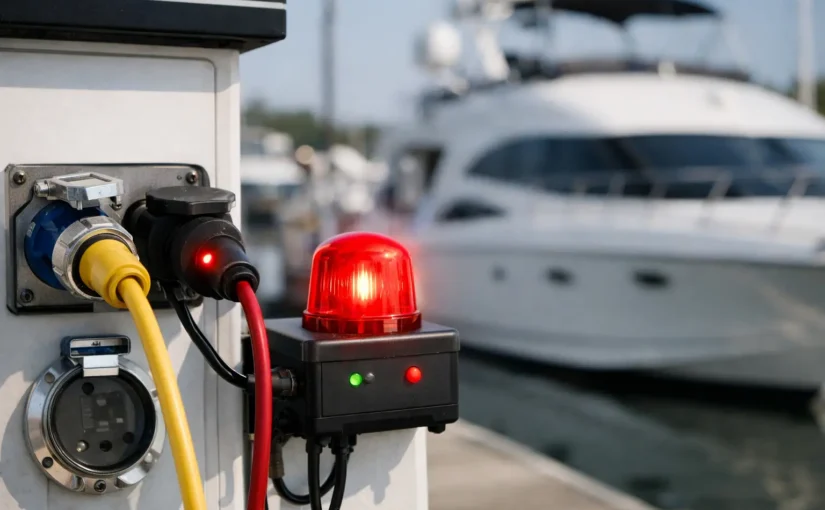
A tripped breaker at 2:00 a.m. does not stay a small problem for long. If your charger goes offline, batteries start dropping, refrigeration warms up, bilge pump readiness changes, and anything depending on AC power starts shifting in the wrong direction. That is exactly why a boat shore power alarm matters. It is not just there to tell you the pedestal lost power. It is there to give you enough warning to protect the boat before one fault turns into several.
For many owners, shore power loss is one of the highest-risk dockside events because it often happens when nobody is aboard. You leave the marina with everything stable, and a few hours later a breaker trips, a cord connection overheats, or the dock loses power. If you do not know about it quickly, the real damage shows up later as dead batteries, spoiled provisions, failed dehumidification, frozen or overheated compartments, and reduced bilge pumping capacity.
What a boat shore power alarm actually needs to do
A basic alarm can tell you that AC power disappeared. That is useful, but only partly useful. The real job of a boat shore power alarm is to confirm loss fast, filter out nuisance events, and trigger action while there is still time to respond.
That means the best systems do more than watch a single power state. They connect shore power status to battery voltage, temperature, humidity, bilge activity, and in some cases generator or inverter behavior. If shore power drops for thirty seconds during a marina transfer, that may not require a midnight phone call. If shore power drops and your house bank starts sagging, that is a different event. Good monitoring distinguishes between the two.
Speed matters, but context matters just as much. A useful alarm should tell you what changed, when it changed, and what else is happening on the vessel. That is how an owner decides whether to call the marina, dispatch a captain, or simply keep watching the trend.
Why shore power loss creates bigger problems than most owners expect
At the dock, AC power supports more than convenience loads. It often underpins battery charging, refrigeration, climate control, network equipment, security devices, and pumps that depend on charged DC systems. Once shore power is gone, the boat starts living on stored battery energy.
How long that is sustainable depends on battery health, charger setup, onboard loads, and the type of vessel. A center console with minimal parasitic draw may ride through the event for quite a while. A larger yacht with multiple refrigerators, monitoring gear, entertainment systems, and climate management can burn through reserve capacity much faster.
There is also the question of season and location. In hot climates, losing air conditioning and dehumidification can mean rapid cabin moisture buildup and rising mold risk. In freezing conditions, loss of heat tracing or onboard heat can create a much more urgent systems problem. The alarm itself is only one piece. What matters is whether it gives you enough notice for your specific boat and environment.
The failures a boat shore power alarm should help expose
The obvious event is full pedestal power loss. But many dockside power incidents are not that simple. A useful system should help you catch several failure paths, not just one.
One common issue is a tripped breaker, either at the pedestal or onboard. Another is a disconnected or degraded shore cord, especially where plugs see corrosion, heat, movement, or poor contact pressure. Some failures are upstream marina issues. Others begin on the vessel with charger faults, transfer switch problems, or overloaded circuits.
Then there are the slow-burn cases. Shore power may still appear present, but charging is compromised. Or one part of the AC system is down while another still looks normal. If your monitoring setup only says power yes or no, you can miss the warning signs. That is why battery trend data matters. A charger that is not doing its job will often reveal itself through voltage behavior before the situation becomes critical.
Standalone alarm or full remote monitoring?
This is where trade-offs start to matter. A simple local alarm is cheaper and easier to install. If someone is nearby to hear it, it may be enough for a lightly used boat in a highly attended marina. But many owners are not nearby. They are at home, traveling, or storing the boat seasonally. In those cases, a siren on the vessel has limited value.
A remote boat shore power alarm gives you a very different level of protection. Instead of waiting for your next dock visit, you get notified through an app, text, email, or phone alert when the condition changes. That shortens response time, and response time is usually what determines whether the event stays manageable.
A full monitoring system also reduces blind spots. If shore power fails and your batteries remain healthy, you may have time. If shore power fails and water intrusion starts, that is a much higher-priority event. Seeing those signals together is far more useful than receiving isolated alarms from disconnected devices.
What to look for in a remote shore power monitoring system
Marine conditions punish weak hardware. A boat is wet, hot, cold, vibrating, and electrically noisy. Consumer-grade sensors and generic smart-home devices do not hold up well in that environment, and they are rarely designed around marine wiring standards.
Look for marine-grade hardware, clean installation practices, and ABYC-aligned electrical thinking. If the system is going to watch a critical input like shore power, it should be designed for real vessel conditions, not adapted from residential automation.
Connectivity is another major factor. If your system depends on a single path to communicate, you have another failure point. Dual connectivity options such as LTE and Wi-Fi improve the odds that alerts still get out when conditions change. Alert delivery matters too. Push notifications are useful, but for higher-risk conditions many owners want text, email, and phone-call escalation.
App visibility should be practical, not flashy. When power drops, you want to open the app and immediately see shore power status, battery voltage, recent bilge activity, temperature, and event history. You should not have to guess whether the issue is isolated or cascading.
For advanced owners, expandability counts. A shore power alarm becomes far more valuable when it sits inside a wider monitoring architecture that can also watch bilge, battery banks, GPS position, doors, hatches, tank levels, and NMEA2000 data. That gives you one system watching the boat instead of several disconnected gadgets competing for your attention.
Installation and setup are part of the alarm’s value
Even a strong monitoring platform can disappoint if setup is sloppy. Sensor placement, wiring quality, alert thresholds, and notification rules affect how useful the system feels day to day.
If alerts are too sensitive, you get nuisance notifications and start ignoring them. If they are too loose, you lose response time. The right setup depends on your boat. A vessel in a marina with frequent short outages may need a delay threshold before triggering a critical power-loss alert. A boat in long-term storage may need a stricter rule because nobody is checking it in person.
You also want to think through the response chain. Who gets the alert first? Just the owner, or also a captain, yard manager, or family member? The best alarm is the one that reaches the right person fast enough to do something useful.
When a boat shore power alarm pays for itself
Most owners do not buy monitoring because they want more data. They buy it because the cost of one missed event can easily exceed the cost of prevention. Dead batteries, spoiled refrigeration, emergency service calls, moisture damage, and preventable pump failures are expensive on their own. On a larger vessel, the numbers climb quickly.
The value is not only in avoided repairs. It is also in certainty. If you travel often, keep the boat in another state, or manage multiple vessels, remote awareness changes how you operate. You stop relying on assumptions and dockside luck. You know whether the boat is powered, charging, dry, and where it should be.
That is the reason many owners move past a single-purpose alarm and into a connected monitoring platform such as EverWatch. Shore power is critical, but it is rarely the only thing worth watching.
A good boat shore power alarm does one job above all else – it buys you time. And on an unattended boat, time is usually the difference between a simple reset and a very expensive problem.


 2-Year Warranty
 30-Day Money-Back Guarantee
 U.S.-Based Support