
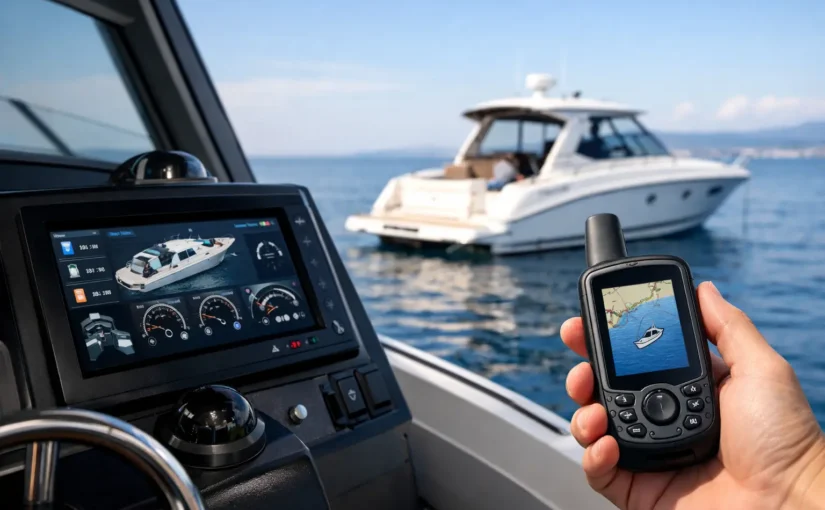
If your boat loses shore power at 2:13 a.m., a GPS tracker will still show you exactly where it is. That will not save your batteries, stop the bilge pump from overworking, or tell you water is rising in the hull. That is the real issue in boat monitoring vs GPS tracker – one tells you where the vessel is, while the other tells you whether the vessel is actually safe.
For many owners, that difference only becomes obvious after a dead battery bank, a soaked cabin, a failed freezer, or a call from the marina. Position matters. Condition matters more. If your boat spends long stretches unattended at a dock, on a mooring, in dry storage, or at anchor, remote awareness has to go beyond a moving dot on a map.
Boat monitoring vs GPS tracker: the core difference
A GPS tracker is built to answer a narrow question: where is the asset right now, and where has it been? For theft recovery or fleet location, that can be useful. Some trackers also add simple movement alerts or geofencing, which helps if the boat leaves a permitted area.
A boat monitoring system is built around a broader mission: detect problems early and alert the owner before those problems become damage. That means monitoring systems, not just movement. Shore power status, battery voltage, bilge activity, high water, cabin temperature, humidity, door or hatch openings, anchor drag, and onboard network data all become part of the picture.
That distinction matters because most expensive boat incidents do not start with theft. They start with quiet failures. A charger goes offline. A battery discharges. A bilge pump cycles too often. A hatch is left open before a storm. Heat and humidity build up in storage. By the time someone physically notices, the repair bill is already growing.
What a GPS tracker does well
A fair comparison starts with the tracker’s strengths. GPS trackers are good at location reporting. If your main concern is unauthorized movement, trailering, or theft recovery, a tracker can play a useful role. It can confirm whether a boat has left the marina, moved outside a geofence, or changed position unexpectedly.
Trackers are also often simple to understand. Many owners like the straightforward promise: install the device, check the app, see the boat’s location. In low-complexity use cases, that can be enough.
For example, if you keep a center console on a trailer in a secure yard and your biggest worry is someone towing it away, a GPS tracker may cover the highest-risk event. It gives you movement intelligence. That is valuable.
But that value has limits. A tracker usually does not tell you why the batteries died, whether shore power failed, or whether water entered the bilge while the boat remained perfectly stationary.
Where GPS trackers fall short on boats
Boats are not cars, and that is where consumer-style tracking logic breaks down. Marine risk is less about driving behavior and more about unattended system failure. A vessel can sit in the same slip for weeks while conditions onboard steadily worsen.
A basic tracker will not usually monitor battery health in a meaningful marine context. It will not watch bilge pump run frequency and flag abnormal activity. It will not detect shore power loss on a docked vessel, and it will not warn you that humidity is climbing high enough to invite corrosion, mildew, and cabin damage.
There is also the durability question. The marine environment is harsher than many tracking products are designed for. Moisture, vibration, heat, salt exposure, and inconsistent power conditions all punish marginal hardware. A tracker that works fine in a car or equipment yard may not be the right fit for a boat that lives through marina power interruptions, washdowns, and seasonal storage.
Connectivity matters too. If a device depends on a single communication path or has weak alert options, you may not know there is a problem until too late. On a boat, missed alerts are not a minor inconvenience. They can mean engine room damage, battery replacement, water intrusion, or lost time during a short boating season.
What boat monitoring is designed to prevent
A true boat monitoring system is there to watch, detect, and respond across the systems that actually create risk. It acts more like a remote set of eyes on the vessel than a simple locator.
That means it can alert you when shore power is lost before batteries collapse. It can show low voltage trends before electronics start shutting down. It can report bilge activity that suggests a leak, failed float switch behavior, or pump overuse. It can flag high water events that demand immediate action.
Environmental monitoring is equally practical. Temperature alerts can protect cabins, mechanical spaces, and stored gear during freeze conditions or summer heat. Humidity visibility helps owners protect interiors, soft goods, and electronics. Door and hatch sensors add another layer of security for boats left unattended at marinas or storage facilities.
More advanced systems go further by integrating with onboard data networks. For owners who want deeper vessel oversight, NMEA2000 visibility can extend remote awareness into engine data, tank levels, and transmission information. That is a different class of protection than simply knowing whether the boat moved.
Boat monitoring vs GPS tracker for real ownership scenarios
The right choice depends on what you are trying to protect against.
If the primary concern is theft or unauthorized movement, a GPS tracker may be enough. It can tell you the boat has left the dock, crossed a boundary, or changed location. For some low-use boats with minimal onboard systems, that may be an acceptable baseline.
If the primary concern is preventing costly damage while the boat is unattended, a monitoring system is the better fit. Most owners with larger boats, shore power dependence, battery banks, bilge pumps, refrigeration, or sensitive onboard electronics need condition alerts more than simple location reporting.
Consider a cruiser in a marina slip. The highest-probability problems are not dramatic theft events. They are shore power interruption, battery drain, bilge issues, humidity buildup, and unauthorized access. In that case, a GPS-only approach covers the least likely problem and misses the failures most likely to cost money.
Now consider a yacht owner who travels often and leaves the vessel unattended for weeks. That owner needs persistent oversight, timely alerts, and confidence that the vessel’s systems are being watched around the clock. A tracker cannot provide that level of operational visibility.
For multi-vessel operators, the gap gets even wider. Managing several boats means needing fast exception-based alerts, not just map positions. You need to know which vessel lost power, which one has abnormal bilge activity, and which one has a low battery condition. That is what monitoring is built for.
Why marine-specific system design matters
This is where many comparisons get too shallow. It is not only about features on a checklist. It is about whether the system was designed for marine conditions and marine consequences.
Marine-grade hardware, proper wiring practices, and ABYC-aligned installation standards matter because reliability matters. If an alert system fails during the exact event it was meant to detect, the spec sheet does not help you. The same goes for connectivity. Dual-path communication through LTE and Wi-Fi gives owners a better chance of staying informed when one path is compromised.
Alert delivery matters just as much. Push notifications are useful, but serious events often need layered alerts through text, email, and phone calls. Boat owners do not need passive data collection. They need timely, unmistakable notice when intervention is required.
That is why a dedicated marine platform like EverWatch is positioned differently from a generic tracker. It is built to monitor vessel condition continuously, not just report coordinates.
So which one should you choose?
If your question is, “Where is my boat?” a GPS tracker answers it.
If your question is, “Is my boat safe right now?” you need boat monitoring.
For many owners, the honest answer is that location should be one feature inside a larger monitoring system, not the whole system. GPS has a role. It is just not the whole job. A boat can be exactly where you left it and still be one failed shore power cord away from a major problem.
The best protection comes from early detection paired with reliable alerting. That is what gives you time to call the marina, contact a captain, send a technician, or get to the boat before a small issue becomes a major repair.
When you evaluate your options, think less about tracking and more about exposure. Ask what can go wrong while the boat is sitting still. That is usually where the real cost lives – and where real monitoring earns its keep.
Your boat does not need occasional check-ins. It needs constant oversight when you are not there.


 2-Year Warranty
 30-Day Money-Back Guarantee
 U.S.-Based Support