
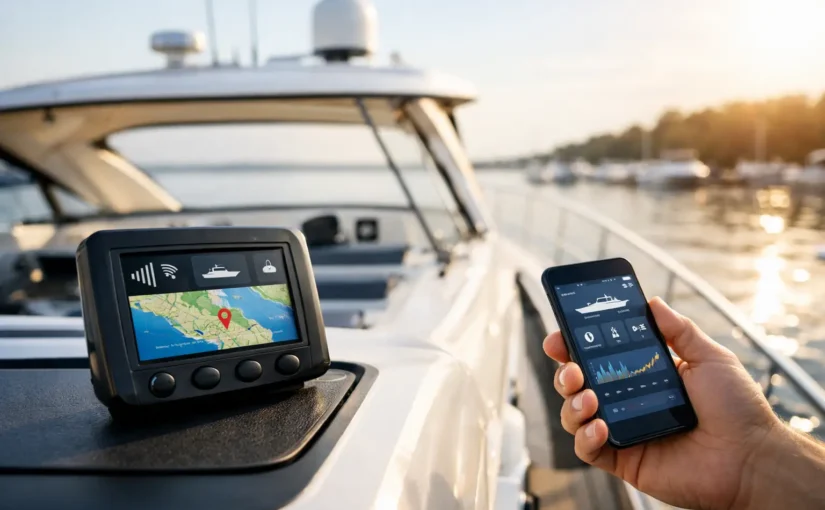
You do not usually lose a boat all at once. It starts with a tripped breaker, a weak battery bank, a bilge pump that cycles too often, or a hatch left unsecured before a storm. A cellular boat monitoring system exists for that exact gap between normal conditions and expensive damage. It keeps watch when you are not at the dock, not in the yard, and not close enough to catch the first warning sign.
For many owners, that first warning sign is the difference between a simple service call and a major insurance claim. Shore power drops overnight. Cabin temperature spikes in storage. Water intrusion begins slowly. A boat shifts outside its expected position. None of these issues are rare, and none improve by waiting until the next weekend visit.
What a cellular boat monitoring system actually does
A cellular boat monitoring system gives you remote visibility into the systems and conditions that matter most on an unattended vessel. At the most basic level, that means the onboard controller gathers data from sensors and sends alerts to your phone when something changes outside normal limits.
The good systems go much further than a simple tracker or a standalone bilge alarm. They monitor shore power status, battery voltage, bilge activity, high water, temperature, humidity, doors, hatches, and location. More advanced setups can also pull NMEA2000 data for engines, transmissions, and tanks, which matters if you want a more complete operating picture instead of a few isolated alarms.
That broader view is what makes the system useful in daily ownership, not just in emergencies. You are not only waiting for bad news. You are confirming that the boat is powered, batteries are charging, the cabin environment is stable, and the vessel is where it should be.
Why cellular matters more than many owners think
A lot of remote products claim coverage, but the connection type determines whether the system is dependable when conditions change. Cellular matters because boats are often left in places where local Wi-Fi is inconsistent, marina networks are overloaded, or no internet service exists at all.
A cellular connection gives the boat its own path to communicate. That reduces dependence on a dockside network you do not control. If your marina router goes down or the yard changes credentials, the monitoring system should not go blind.
There is a trade-off, of course. Cellular service adds an ongoing subscription cost, and signal strength varies by region and marina layout. Metal structures, covered slips, and remote anchorages can affect performance. That is why connection strategy matters. The strongest systems use cellular as a primary remote path and can also use Wi-Fi when available, giving you more coverage options instead of forcing an either-or decision.
The real problems boat owners are trying to prevent
Most buyers are not shopping for technology for its own sake. They are trying to stop a known list of costly events.
Shore power loss is near the top. Once power fails, battery chargers stop, refrigeration warms, dehumidifiers shut off, and battery banks begin to drain. If the outage lasts long enough, what started as a dockside inconvenience can cascade into dead batteries, spoiled contents, or disabled pumps and onboard systems.
Bilge and water intrusion are equally urgent. A bilge pump that runs more often than usual may be the first sign of a leak. High-water detection is even more serious. By the time water is visible from the dock, the problem is already advanced. Remote alerts buy time, and time is what limits damage.
Unauthorized movement is another major concern, especially for boats kept in open marinas, storage lots, or on moorings. GPS position alerts and geofencing help you catch movement that should not be happening, whether that means theft, drifting, or a vessel moved unexpectedly for service.
Environmental conditions matter more than many owners expect. Excess humidity can damage interiors and electronics. Heat and freezing temperatures can impact equipment, plumbing, and stored contents. A monitoring system that tracks these conditions helps protect the boat during off-season storage and long idle periods, not only during active boating months.
Not all systems are built for marine use
This is where many owners make a costly mistake. They piece together consumer trackers, home security sensors, and generic IoT devices and assume they now have boat monitoring. On paper, that looks cheaper. In practice, it often creates blind spots, wiring issues, and weak reliability in a harsh marine environment.
A boat is not a garage and not a vacation home. It deals with moisture, vibration, corrosion, fluctuating power conditions, and long periods unattended. Hardware has to be marine-grade. Wiring practices should align with ABYC expectations. Alerts must reach you through more than one channel, because a single push notification is not enough if the event is urgent.
The installation approach matters too. A system that can expand as your needs change is more useful than one fixed box with a few basic inputs. Some owners only need shore power, battery, and bilge monitoring at first. Others want full location coverage, door and hatch status, anchor alerts, and NMEA2000 integration. A serious platform should support both without forcing a full replacement later.
What to look for in a cellular boat monitoring system
Start with the conditions that can cause the fastest or most expensive damage on your boat. For many owners, that means shore power, battery health, bilge activity, high water, and GPS location. If those five areas are covered well, you have the foundation of meaningful protection.
Then look at alert delivery. App notifications are useful, but urgent situations demand escalation. SMS, email, and phone call alerts create redundancy. If the event is critical, the system should keep trying to reach you.
Connection flexibility is another major factor. A cellular boat monitoring system with dual connectivity, using LTE and Wi-Fi where available, gives you more dependable reporting than a single-path setup. That matters at marinas, in indoor storage, and at remote moorings where conditions change.
For technically inclined owners, integration is the next threshold. NMEA2000 support can bring engine, transmission, and tank data into the same monitoring environment. That does not replace helm instrumentation, but it does extend visibility when you are away from the boat. For multi-vessel operators or owners managing larger yachts, that added data depth can be worth far more than a simple tracker ever could.
Who benefits most from this kind of protection
Seasonal owners benefit because their boats often sit unattended for long stretches. Traveling owners benefit because distance turns every dockside issue into a timing problem. Multi-vessel operators benefit because one app-based view is far easier to manage than checking each boat separately through local contacts.
Even owners who visit often gain value. Most damage events do not wait for your next walk-through. They happen at 2 a.m., during a weather shift, after a power interruption, or while the marina is quiet. Constant oversight changes the response window.
That is the real return on investment. It is not just about gadgets or convenience. It is about catching the problem while it is still small enough to control.
EverWatch Systems is built around that idea, with marine-grade hardware, expandable sensors, app-based visibility, and alerting designed for unattended boats in real operating conditions. That kind of platform fits the way serious owners protect real assets, not the way consumer smart devices are marketed.
The buying decision comes down to one question
When your boat is unattended, how long can a problem go unnoticed before the cost becomes painful?
If the honest answer is a few hours, or even one overnight stretch, then remote monitoring is no longer a nice add-on. It is part of responsible ownership. The right cellular boat monitoring system gives you eyes on the boat when you cannot be there, and that changes everything about how quickly you can act.
A boat does not need constant attention from you. It needs constant watch. That is the standard worth buying for.


 2-Year Warranty
 30-Day Money-Back Guarantee
 U.S.-Based Support