
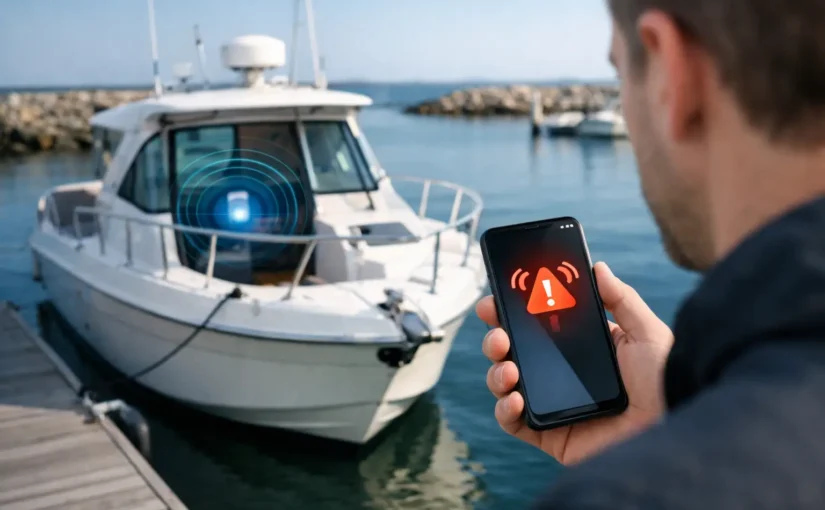
You do not find out your bilge is cycling too often, your shore power has dropped, or your boat has started moving when it is convenient. You find out after the batteries are flat, the cabin smells like mildew, or the marina calls with bad news. A boat alert system with phone notifications changes that equation. It puts the first warning in your hand while there is still time to act.
For boat owners who leave a vessel at a slip, in dry storage, on a mooring, or at anchor, the value is simple. Early detection prevents expensive damage. The best systems do more than send a generic app ping. They monitor the right marine conditions, deliver alerts through more than one channel, and keep reporting even when the boat is unattended for weeks.
What a boat alert system with phone notifications should actually do
A real marine monitoring system is not just a GPS tracker and it is not just a battery sensor. A capable setup watches the systems that most often create costly surprises. That usually starts with shore power status, battery voltage, bilge pump activity, high water, temperature, humidity, and unauthorized movement.
On many boats, those basics cover the highest-risk scenarios. Shore power loss can quietly lead to dead batteries, warm refrigerators, and failed chargers. Repeated bilge pump activity can signal a leak before it becomes flooding. High cabin heat and humidity can damage interiors, electronics, and soft goods. GPS position and geofencing help detect theft, dragging anchor, or unexpected movement after a storm.
More advanced owners usually want visibility beyond basic alarms. That is where support for doors, hatches, water intrusion, tank levels, and NMEA2000 data starts to matter. If your system can report engine data, transmission status, and fuel or water tank levels, you are no longer just reacting to emergencies. You are supervising the vessel remotely.
Phone notifications are only useful if they are fast and hard to miss
A notification that arrives late is not much of a safeguard. Neither is one buried in a crowded app feed. A strong boat alert system with phone notifications should send immediate push alerts and also support SMS, email, or even phone calls for high-priority events.
That multi-channel approach matters on the water. Some owners keep push alerts on at all times, while others rely on text messages for urgent conditions. A phone call can be the difference between seeing an alert in ten minutes and seeing it now. If the event is serious enough, the system should escalate.
The same logic applies to connectivity. If your monitor depends on a single communication path, you have a single point of failure. Boats move between marinas, storage yards, and anchorages. Wi-Fi can be inconsistent. Cellular coverage can vary. Systems that support both LTE and Wi-Fi are better positioned to stay connected and keep alerts flowing.
The difference between marine-grade and consumer-grade monitoring
A lot of owners start by piecing together consumer smart devices. On paper, that can look cheaper. In practice, it often creates blind spots.
Consumer sensors are rarely built for vibration, moisture, salt exposure, and fluctuating power conditions. They may work in a garage or vacation home, but boats are harsher environments with more electrical complexity and more serious consequences when something fails. A boat monitor should be designed for marine conditions, not adapted to them.
Installation standards matter too. Marine systems should respect proper power management, safe wiring practices, and ABYC-aligned installation principles. That is not just a technical detail. It affects reliability, battery draw, fault tolerance, and long-term safety.
This is also where expandable architecture becomes important. Boats are not all the same. A center console in seasonal storage has different monitoring needs than a diesel sportfish, a cruising sailboat, or a multi-vessel fleet. You want a platform that can start with core alerts and add sensors as your needs change, rather than forcing a one-size-fits-all package.
Which alerts matter most for unattended boats
Every owner has a slightly different risk profile, but a few alert categories carry the most value for most vessels.
Shore power loss is near the top because it can trigger a chain reaction. Once AC power drops, chargers stop, batteries begin discharging, refrigeration may fail, and onboard systems can go offline. What starts as a pedestal issue can become a battery replacement, spoiled provisions, or a systems service call.
High water and bilge activity are equally critical. If the bilge pump runs more often than normal, something has changed. Catching that change early gives you options. Waiting until the boat is visibly low in the slip does not.
Battery health alerts are another core safeguard. Low voltage can disable security devices, pumps, and connectivity. The system that is supposed to warn you cannot help much if it has already gone dark.
Location-based alerts are essential for theft prevention and anchor monitoring. A geofence alarm can tell you the boat has moved from its expected position. For owners who leave vessels on moorings or at anchor, anchor drag alerts add another layer of protection when conditions shift.
Environmental alerts are often underestimated until damage appears. High temperature, freezing conditions, and elevated humidity can harm interiors, systems, and stored gear. These are not dramatic events, but they are expensive over time.
Choosing the right system depends on how you use your boat
If your boat stays at a marina with reliable shore power, you may prioritize AC status, battery condition, bilge alerts, and security sensors on doors or hatches. If you store it remotely, cellular connectivity and GPS visibility may matter more than marina Wi-Fi. If you cruise or anchor out regularly, movement alerts, anchor status, and battery monitoring become more important.
Owners of larger or more complex boats should look closely at integration depth. NMEA2000 support can bring engine, transmission, and tank data into the same app that handles your alerting. That creates one monitoring environment instead of a patchwork of separate devices and dashboards.
Fleet operators and owners with more than one vessel have another layer to consider. They need one place to monitor all boats, clear alert prioritization, and a service model that supports persistent oversight instead of occasional check-ins. In that case, the app experience matters just as much as the onboard hardware.
What to ask before you buy
The right questions are practical. How are alerts delivered? What happens if Wi-Fi drops? How many sensors can the system support? Can it monitor bilge activity, shore power, battery voltage, location, temperature, and humidity from one platform? Is the hardware marine-grade? Does the installation align with accepted marine electrical practices? Can you add engine and tank data later?
You should also ask how the system handles real ownership, not just ideal conditions. Boats sit through storms, power interruptions, and long periods without a person onboard. They may be hauled, moved, or covered for the season. The monitor should continue doing its job without constant babysitting.
A subscription model is often part of that reliability. Some owners hesitate at recurring service fees, but the trade-off is usually ongoing connectivity, cloud access, app services, and continuous alert delivery. For many boaters, that is exactly the point. You are not buying a one-time gadget. You are paying for constant watch.
EverWatch Systems is built around that idea – marine-grade hardware, dual LTE and Wi-Fi connectivity, expandable sensors, app-based visibility, and multi-channel alerts that help owners respond before minor issues become major claims.
Why the cheapest option often costs more
A low-priced tracker or standalone alarm can cover one problem well enough. The trouble starts when you need it to cover five problems at once. Then you are managing multiple apps, separate batteries, uneven connectivity, and devices that do not share data.
That patchwork can work for a while, but it usually fails at the exact moment you need confidence. Boat protection is stronger when monitoring is centralized, purpose-built, and designed around marine failure points. One coordinated system gives you faster awareness and fewer gaps.
The real standard is not whether a device sends a notification. It is whether that alert arrives fast enough, with enough context, and through a reliable enough channel that you can do something about it.
If you are trusting a system to watch your boat when you cannot, choose one that watches like a boat owner would – constantly, critically, and with no room for guesswork.


 2-Year Warranty
 30-Day Money-Back Guarantee
 U.S.-Based Support