
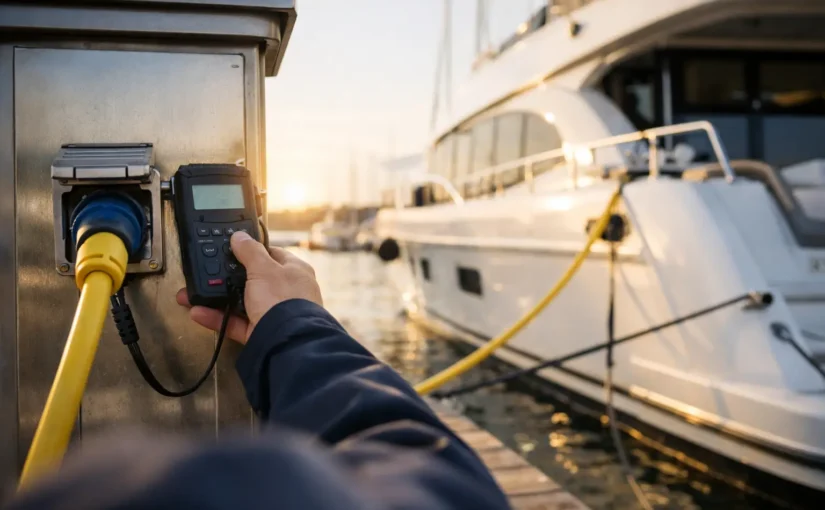
A boat can look perfectly fine from the dock while a shore power failure is already setting up an expensive problem. The charger stops. Batteries begin to fall off. Refrigeration warms up. Bilge pumps lose dependable backup charging. Cabin humidity climbs. If you are not there when it happens, hours matter. That is exactly why monitor shore power continuously is such a practical question for any owner who leaves a vessel unattended.
Why monitor shore power continuously when the pedestal seems fine?
Because shore power problems rarely announce themselves in a way you can see from a distance. A tripped breaker, a loose cord connection, marina outage, corroded inlet, failing charger, or accidental unplug can all interrupt AC supply without any obvious warning to the owner. The boat may still be tied securely in its slip, but key onboard systems have already shifted to battery-only operation.
That is where risk starts to compound. A single missed shore power loss event can lead to low batteries, dead pumps, spoiled provisions, drained starter banks, and electrical troubleshooting that gets more expensive the longer it goes unnoticed. Continuous monitoring changes the timeline. Instead of finding the problem days later, you know when it starts.
For seasonal owners, traveling owners, and anyone keeping a boat at a marina full-time, that difference is not minor. It is the difference between prevention and damage control.
Shore power loss is rarely just one problem
Many boat owners think of shore power as a convenience feature. It is more accurate to think of it as a support system for several other critical functions.
When shore power drops, battery chargers stop maintaining the bank. On a lightly loaded boat with healthy batteries, you may have time. On a vessel running refrigeration, network gear, security devices, or other DC loads, that reserve can disappear faster than expected. Older batteries shrink the margin even more.
The next issue is what those batteries are supporting. Bilge pumps may still run on DC, but without charging input, every pump cycle takes you closer to a low-voltage event. If a packing gland starts dripping more than usual, a hose lets go, or rainwater finds its way in, your pumps need battery capacity behind them. Continuous shore power monitoring helps protect that capacity by telling you when charging support is gone.
Then there are the less dramatic but still costly consequences. Air conditioning shuts down. Cabin temperature rises. Humidity builds. Electronics sit in a harsher environment. Refrigeration and freezers stop holding temperature. If the boat is unoccupied for several days, what started as a simple power interruption can become mold, odor, water intrusion risk, and a battery recovery job.
The real cost of not knowing
The most expensive part of shore power loss is often not the outage itself. It is the delay.
If you know immediately, you can call the marina, ask a neighbor to check the pedestal, dispatch a captain, or head down yourself. In many cases, the fix is simple. Reset a breaker. Reconnect a cord. Address a pedestal issue. Catch a charger fault before the battery bank is deeply discharged.
If you find out two or three days later, the picture changes. Batteries may be heavily depleted or damaged. Pump reliability may be compromised. Refrigeration may be lost. Sensitive electronics may have seen unstable conditions. And if bad weather passed through while the boat was unsupported, the risk rises again.
That is why continuous monitoring is not about convenience alerts. It is about compressing response time.
Why monitor shore power continuously instead of checking manually?
Manual checks work only when you are present, and most failures happen when owners are away. Weekend visits, marina walk-throughs, or asking someone to glance at the boat are not the same as active oversight.
A shore power issue can start ten minutes after you leave the dock. It can happen at midnight. It can happen while you are traveling, during a storm, or after a neighboring vessel causes a pedestal problem. Manual inspection gives you snapshots. Continuous monitoring gives you visibility between those snapshots, which is where most preventable damage begins.
There is also a false sense of security that comes from seeing charger lights or AC panels during a visit. That tells you the system is working at that moment. It does not tell you whether power failed six hours earlier and came back, whether voltage was unstable overnight, or whether another interruption will occur before morning. Persistent monitoring is built for unattended time, which is when boats are most vulnerable.
Continuous monitoring supports the whole electrical picture
The smartest approach is not to watch shore power as a standalone signal. It is to connect shore power status with battery health and related boat conditions.
If shore power is lost but batteries remain healthy, your response window may be manageable. If shore power drops and battery voltage starts trending down fast, the urgency is higher. If the same event is followed by bilge pump activity or a high-water alert, you are no longer dealing with a simple dockside inconvenience. You are looking at an escalating incident.
This is why serious marine monitoring systems treat shore power as one part of a broader protection stack. AC loss, battery decline, water intrusion, bilge cycling, and onboard environmental changes are connected. Owners need that context, not just a single alarm point.
For more advanced boaters, the value grows when monitoring ties into onboard data systems and a clean alert workflow. NMEA2000 visibility, expandable sensors, and multi-channel alerts are not extra features for the sake of complexity. They reduce the chance that one missed issue turns into several.
The trade-offs boat owners should understand
Not every shore power interruption is a crisis. Sometimes a marina-wide outage is short and harmless. Sometimes a boat has enough battery reserve to ride through it without consequence. Sometimes a charger reboot solves the issue once AC returns. That is the part where context matters.
But uncertainty is exactly why continuous monitoring earns its place. You cannot judge the seriousness of an outage you do not know happened.
There is also a difference between basic alerting and marine-specific monitoring. Consumer smart plugs and generic power sensors may tell you that something went offline, but they are often not designed for the marine environment, the wiring realities of boats, or the need for dependable remote communications. Salt, vibration, moisture, marginal Wi-Fi, and marina power conditions are hard on hardware. A boat deserves a system built for that operating environment.
Installation quality matters too. Shore power monitoring should be part of a properly designed onboard setup, with marine-grade hardware and ABYC-aligned wiring practices. Poor installation can create blind spots, nuisance alerts, or unsafe conditions. Good monitoring should increase trust, not create another maintenance item to worry about.
What a useful shore power alert should actually do
A useful alert is not just a notification that something changed. It should help you respond fast and confidently.
At a minimum, you want immediate notice when shore power is lost and when it returns. You also want the alert delivered through channels you will actually see, whether that is push, text, email, or a call. If the only alert path fails when connectivity gets weak, the system is not doing its job.
The best setups also let you view related vessel conditions in the same app. If AC power drops, can you instantly check battery voltage, bilge activity, cabin temperature, or other connected sensors? That saves time and helps you decide whether to monitor, call someone, or head to the boat right away.
This is where a platform like EverWatch fits naturally for owners who want more than a single-purpose alarm. Shore power monitoring is stronger when it sits inside a 24/7 connected system built to watch the whole vessel, not just one circuit.
Who benefits most from continuous shore power monitoring?
Any unattended boat can benefit, but some owners have more exposure than others.
If your boat stays in a slip full-time, relies on charging support, or sits for days between visits, shore power monitoring should be considered basic protection. The same goes for owners with refrigeration onboard, active dehumidification, security electronics, or bilge systems that depend on battery reserve being maintained.
It is especially valuable for larger boats and yachts with more electrical loads, and for multi-vessel operators who cannot physically inspect every asset every day. Once you are managing more than one boat, manual checking stops being realistic. Remote visibility becomes operationally necessary.
Even trailer boat owners can benefit when vessels are stored with shore power connected for battery maintenance or environmental control. The question is not only where the boat is kept. It is how much can go wrong before someone notices.
Continuous monitoring closes that gap. It gives you early warning while there is still time to act, which is the whole point of protective technology on the water.
A well-kept boat is not just maintained. It is watched, especially when no one is aboard.


 2-Year Warranty
 30-Day Money-Back Guarantee
 U.S.-Based Support