
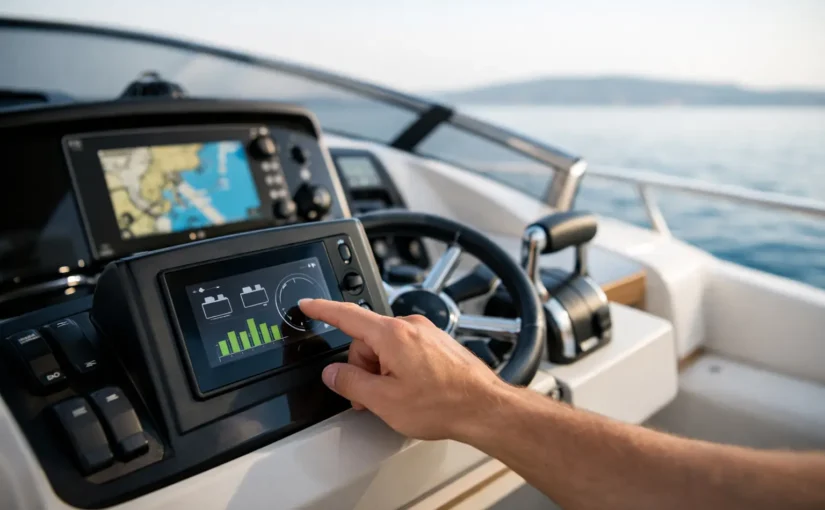
You usually do not find a power problem when it starts. You find it after the cabin is hot, the batteries are low, the charger is offline, or the bilge has cycled more than it should. That is why a guide to boat power monitoring matters. On an unattended boat, small electrical failures become expensive marine problems fast.
Power monitoring is not just about seeing battery voltage in an app. It is about keeping watch on the entire chain – shore power input, charger behavior, battery condition, DC loads, and the conditions that tell you whether the electrical system is stable or drifting toward a failure. If your boat sits at a marina, on a lift, in storage, or at anchor for long stretches, visibility is protection.
What boat power monitoring should actually watch
A useful boat power monitoring setup starts with shore power status. If shore power drops, the rest of the system changes immediately. Battery chargers stop charging. Refrigeration may stop. Cabin temperatures can climb. Depending on the boat, sump pumps, security devices, and network equipment may switch to battery reserve or shut down entirely. A simple notification that shore power was lost is often the first alert that prevents a much larger incident.
Battery monitoring is the next layer. Voltage alone is helpful, but it is not the full story. A resting battery can show acceptable voltage and still have weak capacity. A charger can appear active while the bank is aging badly. The best approach is to watch trends – charging voltage, discharge behavior, low-voltage events, and how quickly the bank recovers after a load. On a vessel with multiple banks, those differences matter even more. House, engine start, thruster, and generator banks do not fail the same way.
The third layer is context. If shore power fails and battery voltage starts dropping, that is meaningful. If shore power fails and bilge pump activity rises, that is urgent. If AC power is restored but one battery bank is still falling, that points to a charger, wiring, fuse, or battery issue. Good monitoring connects these dots instead of showing disconnected data points.
A practical guide to boat power monitoring by use case
The right setup depends on how you use the boat. A center console kept on a trailer has different needs than a yacht left at a marina year-round. The common mistake is under-monitoring boats that spend a lot of time unattended.
If your boat lives at a slip, start with shore power loss, battery voltage, high water, and temperature. These cover the failures that can escalate while nobody is aboard. If the vessel spends nights on the hook or long periods away from power, battery visibility becomes even more important because charging sources may vary between engine alternators, solar, generators, and shore chargers.
For larger boats with multiple systems, NMEA2000 integration can extend monitoring beyond basic power status. That gives owners and managers visibility into engine data, tank information, and other onboard conditions from the same connected system. It is not about adding complexity for its own sake. It is about reducing blind spots.
Multi-vessel operators have another priority: consistency. If every boat has a different charger, wiring history, and battery age profile, remote power monitoring helps you spot the outlier before it becomes a service call, a no-start event, or a dockside emergency.
Shore power monitoring is the first line of defense
Shore power failures are common enough that every marina boater should treat them as a routine risk. Pedestal breakers trip. Cords loosen. Marina power can be interrupted. Corrosion and heat can create intermittent faults that do not look dramatic until they become one.
The value of shore power monitoring is speed. When you know the moment power is lost, you can respond before batteries are deeply discharged and before heat, humidity, or water intrusion become secondary problems. For some owners, that response means calling the marina. For others, it means dispatching a captain, technician, or yard contact. Either way, early notice is what preserves options.
There is a trade-off here. A basic alert that says power is out is better than nothing, but it can also create false confidence. You still need to know what happened next. Did the batteries hold? Did the charger recover when power returned? Did any critical devices stay online? Monitoring should answer those questions, not just announce the first failure.
Battery monitoring without guesswork
Many owners rely on occasional voltage checks. That works when you are aboard often. It fails when the boat is unattended and conditions change between visits.
A stronger setup tracks battery health over time. You want to know when voltage drops below a safe threshold, when a bank is not charging normally, and when recurring drain suggests a hidden load or weak battery. On boats with parasitic draws from stereos, pumps, alarms, or electronics, that pattern can be hard to catch without continuous monitoring.
Battery chemistry also matters. AGM, flooded, and lithium banks behave differently, and their acceptable voltage ranges are not identical. That means alert thresholds should be chosen with the boat’s actual system in mind, not copied from a generic chart. More alerts are not always better. The goal is useful alerts that point to real action.
Installation quality matters more than most owners think
A boat monitoring system is only as dependable as the way it is installed. Marine power environments are not forgiving. Moisture, vibration, heat, and corrosion expose weak wiring decisions quickly.
This is where marine-grade hardware and ABYC-aligned wiring practices matter. Proper fusing, clean terminations, protected cable runs, and correct power sourcing reduce nuisance alerts and improve trust in the data. If the system itself is wired poorly, you have just added another point of failure to an already complex electrical environment.
Connectivity deserves the same attention. Wi-Fi alone can work in some settings, but marina networks are inconsistent and often fail at the exact moment you need visibility. A system with both cellular and Wi-Fi options gives you more dependable remote access and a better chance of receiving critical alerts when local infrastructure is unstable.
Alerts should lead to action
A monitoring system is not valuable because it collects data. It is valuable because it tells you when to act.
For power monitoring, that means building alert logic around real risk. Shore power loss should notify immediately. Low battery voltage may need staged thresholds depending on how fast the bank is dropping. Charger failure may deserve a different alert path than a brief power interruption. If you manage multiple boats or travel often, multi-channel delivery matters too. Push notifications are useful, but SMS, email, and phone call escalation can be the difference between seeing an issue now or discovering it hours later.
This is where a marine-specific platform separates itself from pieced-together consumer devices. Boat owners do not need random sensors sending disconnected warnings. They need one watch system that can detect, correlate, and report conditions in a way that matches how boats actually fail.
What to look for in a complete system
If you are choosing a setup from scratch, focus on coverage before gadget count. You need clear visibility into shore power, battery condition, and related risks such as bilge activity and onboard environment. Expandability matters because most owners add needs over time, whether that is hatch sensors, GPS tracking, anchor monitoring, or NMEA2000 data.
Ease of use matters too, but it should not come at the cost of reliability. A clean app is important. So are marine-grade controllers, stable connectivity, and support from a team that understands boats, not just generic IoT devices. EverWatch is built around that reality – continuous vessel oversight, remote alerts, and marine-specific integration designed for boats that cannot be watched in person every day.
The best guide to boat power monitoring is also the simplest one: watch the power source, watch the batteries, watch the consequences, and make sure alerts reach you fast. When your boat is unattended, electrical visibility is not a convenience. It is part of protecting the vessel itself.
The boat does not need constant hands onboard, but it does need constant awareness. Set up monitoring that catches trouble early, and you give yourself the one thing every owner wants when something starts to go wrong – time to respond.


 2-Year Warranty
 30-Day Money-Back Guarantee
 U.S.-Based Support