
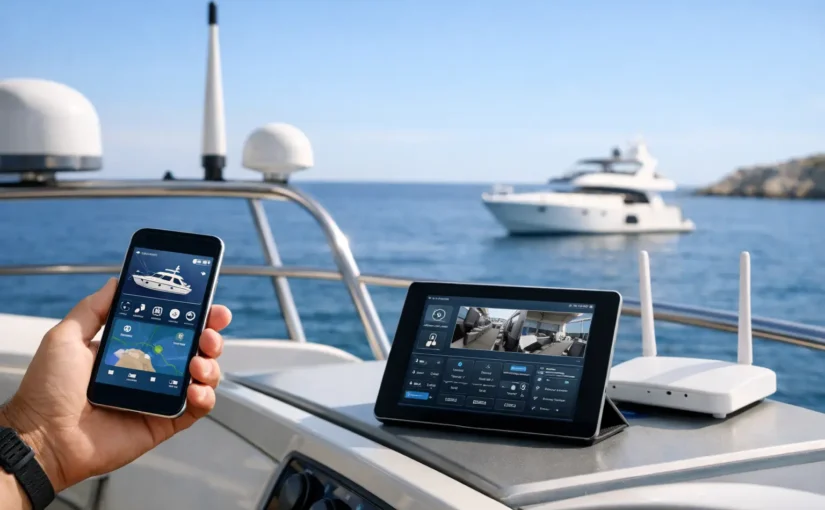
A shore power breaker trips at 2:14 a.m. If your monitoring system only talks when the marina Wi-Fi is healthy, you may not know until batteries start dropping and the fridge, charger, or dehumidifier goes dark. That is the real question behind LTE vs WiFi boat monitoring – not which sounds better on a spec sheet, but which connection still delivers when your boat needs attention fast.
For most boat owners, the answer is not strictly one or the other. It depends on where the boat lives, how often it sits unattended, and what kind of risks you need to catch early. Connectivity is not a side feature in remote monitoring. It is the path between an onboard problem and your phone. If that path fails, the rest of the system matters a lot less.
LTE vs WiFi boat monitoring: the real difference
WiFi boat monitoring uses a local internet network, usually at a marina, boatyard, storage building, or private dock. If the boat can join that network and the network stays online, your monitoring system can send status updates and alerts through it.
LTE boat monitoring uses cellular service. The onboard device connects over a carrier network instead of depending on local Wi-Fi equipment. That means your boat can stay connected even when marina internet is weak, overloaded, misconfigured, or simply out of range.
On paper, both can move data from the vessel to your app. In practice, they behave very differently around the conditions that matter most to boat owners: power outages, distance from access points, changing dock assignments, storage transitions, and long periods without anyone onboard.
Where Wi-Fi works well
Wi-Fi can be a solid option in controlled environments. If your boat stays at a private dock with a strong, dedicated network, or inside a facility with stable internet and good signal coverage to the slip, Wi-Fi may perform just fine. It can also be useful when you want to avoid relying entirely on cellular coverage in an area with poor LTE reception.
There is another practical advantage. If a vessel remains in one place for long stretches, Wi-Fi can be predictable once set up correctly. Some owners also prefer using an existing network as part of a broader property or marina tech setup.
The catch is that marine environments are rarely as controlled as they look. Signal strength can change from one slip to the next. Access points get rebooted. Passwords get updated. Network congestion rises on busy weekends. A router in a dock box or marina office may look close, but fiberglass, metal structures, and distance across the water can weaken performance enough to create blind spots.
Wi-Fi is strongest when the network is yours, the coverage is verified at the boat, and the vessel does not move around much.
Where LTE has the advantage
LTE is built for the exact problem many boat owners are trying to solve: staying connected when nobody is nearby. It does not depend on the marina’s IT setup, the dock office router, or whether someone changed a password while you were out of town.
That independence matters. Boats move between marinas, haul-out yards, service facilities, storage locations, and anchorages. A monitoring system tied only to Wi-Fi can become unreliable or completely disconnected during those transitions. LTE travels with the boat.
It also gives you better odds of maintaining visibility during local internet failures. If the marina network goes down but cellular coverage remains active, your system can still push alerts for high water, low battery voltage, shore power loss, door activity, or unexpected movement. When the goal is early detection, that difference is not minor.
For seasonal owners, traveling owners, and operators managing more than one vessel, LTE usually provides the more dependable baseline connection. It reduces the number of things outside your control.
Reliability is the issue that matters most
Boat monitoring is only valuable when it reports trouble quickly enough for you to act. That is why LTE vs WiFi boat monitoring should be judged first on reliability, not convenience.
A boat can tolerate a lot of ordinary inconvenience. It cannot tolerate missed alerts when bilge activity increases, interior temperature spikes, batteries fall below a safe level, or shore power drops and stays down. These are not app notifications for curiosity. They are warnings that can prevent damage, equipment loss, spoilage, corrosion, discharge events, and theft.
Wi-Fi reliability depends on three separate systems working at once: the onboard device, the local network, and the upstream internet connection. LTE removes the local Wi-Fi network from that chain. Fewer dependency points usually means fewer ways to lose visibility.
That does not mean LTE is perfect. Cellular dead zones exist, especially in remote coves, enclosed storage buildings, or fringe coastal areas. But for many marinas and docks in the US, LTE coverage is more consistent than shared Wi-Fi coverage at the vessel itself.
Cost is part of the conversation, but not the whole story
Some owners start with Wi-Fi because it feels cheaper. If the network already exists, using it can seem like the lower-cost path. That can be true at first glance.
But a boat monitoring system should be measured against the cost of the problem it helps you catch. One missed shore power failure can turn into dead batteries, a warm refrigerator, spoiled provisions, or a disabled charger. One missed high-water event can become far more expensive than a monitoring subscription. One missed unauthorized movement alert can cost far more than years of connectivity.
So the better question is not simply which connection costs less. It is which connection keeps watch more consistently when your boat is unattended.
The best answer is often both
This is where the LTE vs WiFi boat monitoring debate usually lands for serious boat protection: redundancy wins.
A dual-connectivity system uses Wi-Fi when it is available and LTE when it is not, or keeps cellular ready as a backup path. That gives the vessel more than one route to send data and alerts. If the marina internet stumbles, LTE can maintain visibility. If a local Wi-Fi signal is strong and available, the system can use it without depending on it exclusively.
For unattended boats, backup communication is not overkill. It is common sense. The marine environment is hard on electronics, networks, and assumptions. Redundancy is how you keep minor failures from turning into blind spots.
This is especially valuable for owners monitoring more than basic location. Once you are tracking shore power, battery health, bilge cycles, water intrusion, temperature, humidity, doors, hatches, anchor position, and NMEA2000 data, the connection becomes mission-critical. A sophisticated monitoring stack deserves a dependable path out of the boat.
How to choose for your boat
Start with your actual use pattern, not an ideal setup. If the boat stays at one private dock with proven Wi-Fi coverage and you are onboard often, Wi-Fi may cover your needs. If the vessel spends time in marinas, boatyards, storage lots, or on a mooring, LTE is usually the safer foundation.
Then consider risk tolerance. If you only want occasional status checks, you may accept more connectivity limitations. If you want immediate alerts for conditions that can escalate fast, reliability should outrank everything else.
Also think about how much you want to monitor. A simple tracker has different demands than a full vessel monitoring system with environmental, electrical, security, and engine data. The more critical the alert, the less sense it makes to depend on a fragile connection.
For many owners, the strongest setup is a marine-grade system built for constant oversight, with both LTE and Wi-Fi available rather than forcing a choice. That approach fits the way boats are actually used and left unattended. EverWatch is built around that reality, with dual LTE and Wi-Fi connectivity, marine-grade hardware, expandable sensors, app visibility, and multi-channel alerts designed to keep watch when you cannot.
What boat owners get wrong about connectivity
The biggest mistake is treating connectivity like a convenience feature instead of a protection layer. If the system cannot reliably tell you what is happening onboard, then real-time monitoring becomes delayed monitoring, and delayed monitoring often means damage has already started.
The second mistake is assuming marina Wi-Fi at the dock is the same as dependable boat-side performance. It is not. A phone showing one or two bars near the slip does not guarantee stable monitoring traffic around the clock.
The third mistake is buying around best-case conditions. Boats do not only need protection on calm days with stable power and perfect internet. They need protection during storms, outages, haul-outs, travel, and the long stretches when nobody is checking lines or opening the cabin.
If you are comparing LTE vs WiFi boat monitoring, think less about how the system behaves on a good day and more about how it behaves when something goes wrong. That is the day the connection earns its keep.
Your boat does not need a clever app as much as it needs a reliable path to call for attention when conditions change. Choose the connection strategy that keeps watch even when the dock network does not.