
The call usually comes after the damage is done. Shore power dropped two days ago. A battery bank went flat. The bilge pump cycled until it couldn’t. A small leak turned into standing water, mold, and a spring launch delay no owner wanted.
That is why serious owners protect boats during winter storage with more than shrink wrap and a checklist. Winter storage is not just about putting a boat away. It is about controlling risk while the vessel sits unattended through freezing temperatures, storms, power interruptions, and long gaps between visits.
Why winter storage failures get expensive fast
Most winter losses do not start with a dramatic event. They start small. A dead battery means no bilge protection. A failed charger goes unnoticed. A hatch seal leaks during a storm. Interior humidity builds slowly until electronics, soft goods, and joinery start showing the cost.
The problem is time. If a boat sits for weeks without visibility, minor issues have time to become major repairs. That is especially true in marinas and storage yards where power reliability, snow load, wind exposure, and access vary from site to site. Boats stored in the water carry one set of risks. Boats on the hard carry another. Both need active oversight.
Protect boats during winter storage by securing the basics first
Start with the systems that keep the vessel safe when nobody is onboard. Shore power is high on that list. If your boat depends on shore power to maintain batteries, chargers, heaters, or dehumidification equipment, you need confidence that power stays available. The cord connection, pedestal breaker, onboard charger, and battery condition all matter. If one point fails, the rest of the system follows.
Battery health deserves the same attention. Weak batteries are more vulnerable in cold weather, and winter exposes every hidden weakness in a charging setup. If your vessel is left with pumps, alarms, or monitoring equipment active, you need to know voltage is holding where it should. A battery problem is rarely isolated. It tends to trigger a chain reaction.
Bilge protection is another non-negotiable. Even a well-winterized boat can take on water from rain intrusion, failed fittings, plumbing residue, or ice-related movement. A pump that runs more often than normal is an early warning. A high-water condition is a serious event. Owners who wait to discover it during the next marina visit are accepting unnecessary risk.
Water intrusion and humidity need different responses
Water in the bilge and moisture inside the cabin are related, but they are not the same problem. Bilge activity points to ingress below or within the hull system. Cabin humidity points to trapped moisture, poor ventilation, condensation, or a failing cover. One threatens flotation and electrical systems. The other threatens interiors, wiring, and long-term condition.
That distinction matters because the fixes are different. Bilge issues may require pump service, hose inspection, through-hull review, or shore power verification. Interior humidity may require better sealing, airflow, or active climate control. If you only check the boat once a month, both can get out of hand.
The biggest winter storage risks depend on where the boat sits
A boat in the water needs constant awareness of shore power, bilge status, battery condition, and unauthorized movement. If a line parts, a vessel shifts in a storm, or a leak develops, the timeline for response is short. Temperature swings also matter around machinery spaces and plumbing.
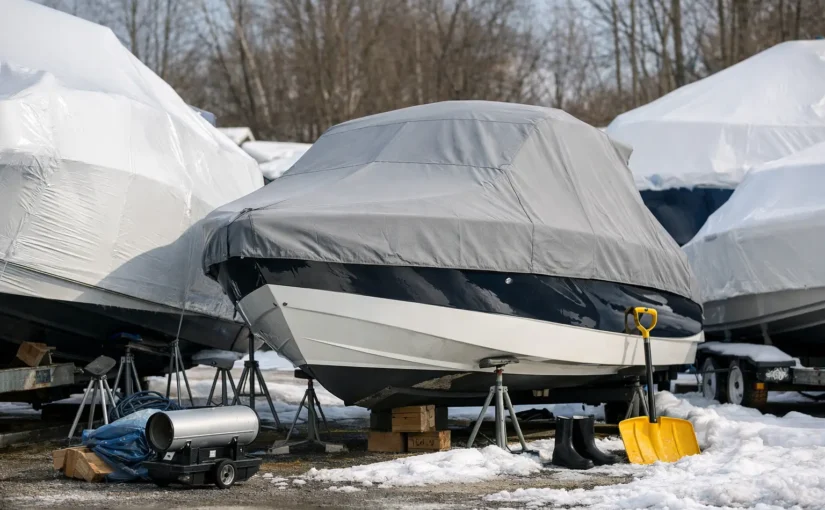
A boat on the hard trades sinking risk for exposure risk. Snow load, cover failure, freeze damage, theft, dead batteries, and interior moisture become more prominent. Yard-stored vessels can also be harder to inspect regularly, especially for owners who travel or keep boats far from home.
Covered storage helps, but it does not remove the need for oversight. A closed building can hide power failures, frozen compartments, and battery drain just as effectively as it hides weather.
Protect boats during winter storage with remote visibility
If the boat is unattended for days or weeks, remote monitoring changes the equation. Instead of relying on a seasonal prep list and occasional walk-throughs, you gain real-time visibility into the conditions that cause winter losses.
The most useful winter monitoring starts with shore power status, battery voltage, bilge activity, high water, temperature, and humidity. Those six data points cover a large share of the incidents that become expensive in storage. If your vessel stays in the water or in a marina environment, GPS position, geo-fencing, hatch status, and door sensors add another layer of security. For more advanced setups, NMEA2000 data can extend visibility into engines, tanks, and onboard systems that should not drift into a fault state unnoticed.
Alerts matter as much as sensors. A monitoring platform should notify you in a way that gets attention fast, whether that means push alerts, text, email, or calls. The point is not just seeing data in an app. The point is responding before a manageable issue becomes a claim.
This is where a marine-specific system earns its keep. Consumer trackers and generic smart sensors may look cheaper at first, but winter storage is where weak connectivity, poor power management, and non-marine hardware show their limits. A system built for vessel environments, with marine-grade hardware, ABYC-aligned installation practices, and cellular plus Wi-Fi connectivity, gives owners a stronger line of defense when conditions are at their worst. EverWatch is built around that kind of persistent oversight.
Winter prep still matters, but it is only half the job
No monitoring system replaces proper winterization. Engines, generators, freshwater systems, sanitation systems, fuel management, and weather protection still need to be handled correctly. If the boat is not physically prepared for storage, alerts only tell you something went wrong after the fact.
But winterization without monitoring leaves a blind spot. You can drain systems, stabilize fuel, disconnect nonessential loads, and secure the cover, then still lose the boat to shore power failure, water intrusion, or theft. Prevention works best when physical prep and active monitoring support each other.
A practical standard for stored boats
For most owners, the right approach is straightforward. Winterize the vessel correctly. Confirm charger and battery performance before storage. Test bilge pumps and float switches. Inspect seals, hatches, and cover tie-downs. Remove unnecessary perishables and moisture traps. Then keep eyes on the boat remotely so you know when conditions change.
The exact setup depends on the boat. A center console on a trailer may need battery, temperature, and location tracking more than bilge oversight. A cruiser in a slip may need full-time shore power, bilge, humidity, and intrusion monitoring. A yacht with complex onboard systems may benefit from broader sensor coverage and NMEA2000 integration. It depends on how the vessel is stored, what stays energized, and how quickly someone can get aboard if an alert comes through.
What owners should not overlook
Many winter problems come from assumptions. Owners assume the marina will notice a pedestal issue. They assume a fully charged battery bank will stay healthy for months. They assume a good cover means a dry interior. They assume theft risk drops in the offseason.
Those assumptions fail every winter. Storage yards are busy. Marina staff cannot monitor every vessel continuously. Weather shifts fast. Boats settle, lines chafe, seals age, and small electrical issues do not fix themselves. If the vessel matters, verification beats assumption.
That applies to response planning too. If you receive an alert for shore power loss or rising bilge water, know who can act. That may be you, a marina manager, a captain, or a service technician. Monitoring is strongest when it is paired with a clear response path.
Peace of mind is really about early detection
Owners often talk about peace of mind as if it is a feeling. In practice, it is visibility. It is knowing whether shore power is live, batteries are healthy, the bilge is quiet, the cabin is dry, and the boat is where it should be. It is having enough warning to step in before winter storage turns into a repair season.
The offseason is when unattended boats are most vulnerable and least observed. Protecting them starts with solid winter prep, but it does not end there. The owners who avoid the worst surprises are usually the ones who can still see what their boat is doing when they are nowhere near it.
If your boat will sit this winter, set it up so silence means everything is normal, not that nobody knows.


 2-Year Warranty
 30-Day Money-Back Guarantee
 U.S.-Based Support